TL;DR
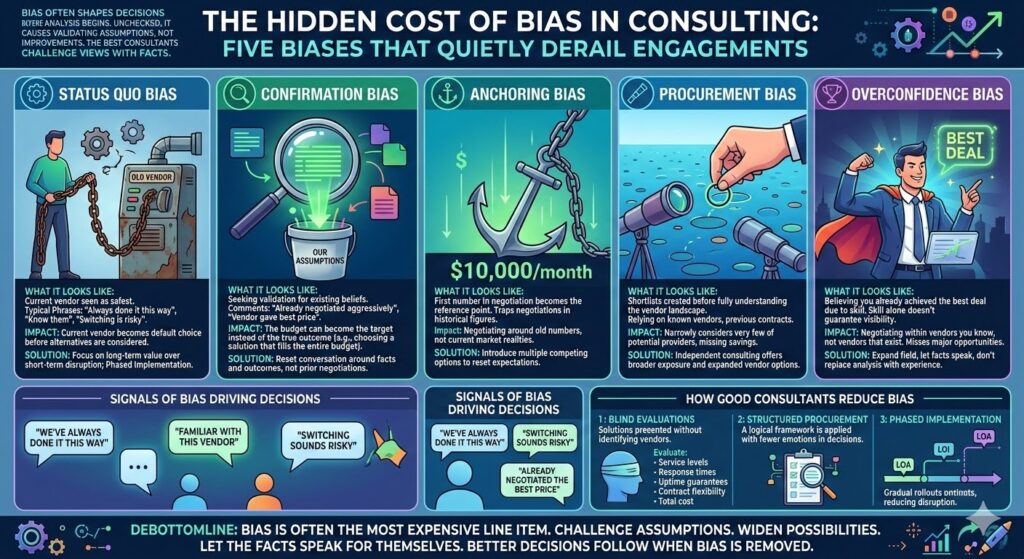
Bias quietly shapes many business decisions before any analysis begins. In consulting engagements, this shows up in vendor loyalty, assumptions about pricing, fear of switching providers, and internal politics. Left unchecked, bias causes organizations to validate bad decisions rather than improve them. The best consultants do more than analyze data. They help organizations recognize the assumptions influencing their decisions and reset the conversation around facts, outcomes, and long-term value.
Why Bias Matters in Consulting
Most organizations believe they make decisions based on numbers.
In reality, many decisions are already made before the numbers are reviewed.
Bias quietly shapes many business decisions before any analysis begins. You can explore broader research that explains how these biases influence real-world choices.
Bias influences how leaders view vendors, how procurement teams build shortlists, and how organizations evaluate risk. By the time a consultant arrives, the decision process often has invisible guardrails.
The problem is not that leaders are careless. Most of them are smart, experienced operators.
The problem is that bias feels like experience.
When consultants fail to recognize this early, they often end up validating assumptions instead of challenging them.
And that is where deals derail.
Five Biases That Quietly Derail Consulting Engagements
Bias rarely shows up as something obvious. It usually appears as reasonable logic or past experience.
But over time, certain patterns repeat themselves across industries.
1. Status Quo Bias
What it looks like
The most common bias in consulting is simple.
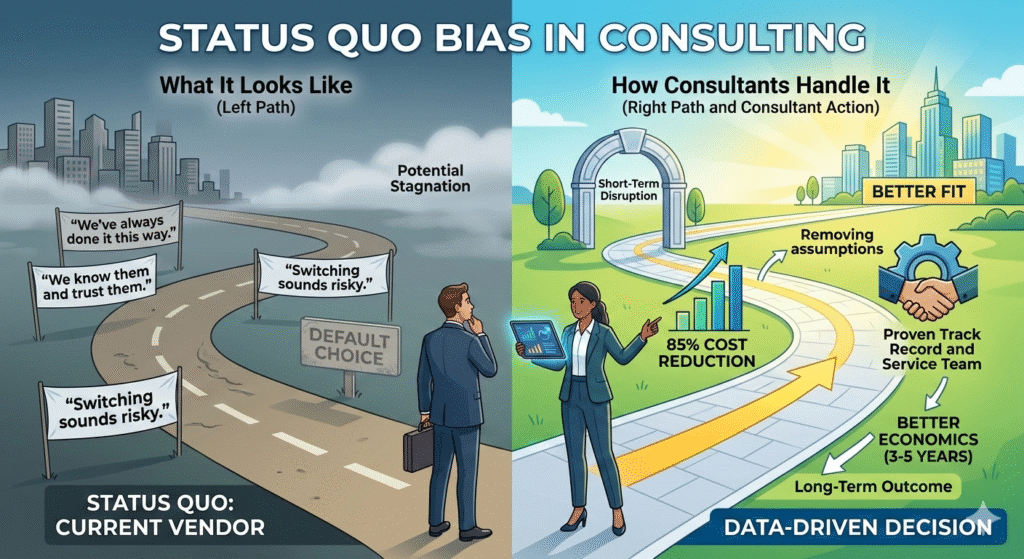
Organizations assume the current vendor is the safest option. This is why we tend to leave things as they are, however, convenient does not always mean correct.
Clients often say things like:
- “We’ve always done it this way.”
- “We know them and trust them.”
- “Switching sounds risky.”
The current vendor becomes the default choice before alternatives are even considered. More about why the status quo is often the most expensive option.
What actually happens
Sometimes the status quo does survive the evaluation.
One of our largest clients stayed with their existing vendor after we completed a full market analysis.
Why? Because we still reduced their costs by 85% while keeping the provider that had a proven track record and great service team.
The real value was not forcing change. The value was removing assumptions and letting the data lead the decision.
How consultants handle it
The conversation often shifts when clients realize something simple:
Moving vendors might create a few months of adjustment, but the next three to five years benefit from better economics and better fit.
When implementation is phased properly, the long-term outcome almost always outweighs the short-term disruption.
2. Confirmation Bias
What it looks like
Organizations often enter an engagement believing they already negotiated the best deal.
They are looking for validation, not analysis.
This shows up in comments like:
- “We already negotiated aggressively.”
- “Our vendor gave us their best price.”
- “We benchmarked this before.”
These are tell tale signs of the poor procurement practices.
What actually happens
One example involved an Air Force recruitment base.
They had a budget of about $52,000 for a printing solution. The vendor proposal filled the entire budget.
The problem was that the solution did not actually match their needs.
What they were offered: 9 machines that made no sense for their environment as if drawn out of a hat.
What they got, 9 devices, specified to their usage for about 35% of their original budget!
Nearly a third the cost of what they believed was already optimized.
The bias was simple. The budget became the target instead of the outcome.
3. Anchoring Bias
What it looks like
The first number in a negotiation often becomes the reference point for every discussion that follows.
If a company has been paying $10,000 per month for a service, then $9,000 suddenly feels like a win.
Even if the real market price is $5,000.
Anchoring bias traps organizations into negotiating around historical numbers instead of market realities and solidifies the necessity for benchmarking.
How consultants reset the anchor
The easiest way to break anchoring bias is to introduce multiple competing options.
Once organizations see three or four real market offers, the old reference point disappears quickly.
Competition resets expectations.
4. Procurement Bias
What it looks like
Procurement teams often create shortlists before fully understanding the vendor landscape.
It is not malicious. It is practical.
Teams rely on:
- vendors they already know
- previous contracts
- internal recommendations
The problem is that in industries like telecom, IT, or print management there may be hundreds of possible providers.
Even experienced procurement teams cannot realistically evaluate every option.
Where consultants add value
One advantage of independent consulting is broader exposure to the vendor market.
Working nationally across many clients creates visibility that internal teams rarely have.
But even consultants must remain aware of bias.
No one can evaluate 500 vendors every time. The goal is to stay disciplined about expanding the field when it matters.
5. Overconfidence Bias
What it looks like
Many organizations believe they already achieved the best possible deal.
This belief usually comes from prior negotiation experience.
But negotiation skill alone does not guarantee market visibility.
Without access to the broader vendor ecosystem, companies may unknowingly optimize inside a limited set of options.
The reality
Most organizations are negotiating within the vendors they know.
Not the vendors that exist.
That difference is where major savings opportunities appear.
How Bias Shows Up in Real Consulting Work
Bias rarely appears in isolation.
It tends to surface in several areas during consulting engagements.
Vendor selection
Organizations often prefer familiar vendors even when alternatives offer stronger economics or service structures.
Broker incentives
In telecom especially, incentives sometimes influence recommendations.
For example, a broker may heavily promote one provider during a quarter when they offer aggressive incentives, then switch recommendations the following quarter when a different vendor offers stronger bonuses.
When incentives drive recommendations, the client outcome becomes secondary.
Internal politics
Stakeholders may defend previous decisions to avoid appearing wrong.
This is human nature.
But it can quietly limit the range of options considered.
Challenging Leadership Bias
Sometimes consultants must confront bias directly.
One conversation with a medical practice made this clear.
A doctor told me she believed a different printer brand would have been the better choice.
So I asked her a question.
“Why don’t you take the afternoon off and I’ll see your patients?”
She looked at me like I was crazy.
Then I explained.
“I spent the last few days learning about being an allergist so I should be good. You spent a few minutes reading about printers online. You brought me in for expertise. Let me do my job.”
The room went quiet.
But the conversation shifted.
Once expertise is recognized, decisions become easier.
Signals That Bias Is Driving the Decision
Certain phrases almost always signal bias.
You will hear them in nearly every consulting engagement:
- “We’ve always done it this way.”
- “We’re familiar with this vendor.”
- “Switching sounds risky.”
- “We already negotiated the best price.”
When those phrases appear, the real consulting work begins.
How Good Consultants Reduce Bias
The best consulting engagements create distance between assumptions and decisions.
Several techniques help accomplish this.
Blind evaluations
One effective approach is presenting solutions without identifying the vendor initially.
Clients evaluate what actually matters:
- service levels
- technician response times
- uptime guarantees
- contract flexibility
- total cost
Vendor identity becomes secondary to outcomes.
Structured procurement
When procurement follows a clear framework, emotional factors have less influence on the final decision.
Phased implementation
Change feels risky when it appears sudden.
Phased rollouts reduce disruption and make transitions manageable.
Using tools like Letters of Authorization and Letters of Intent allows implementation to occur on the client’s timeline rather than forcing an immediate switch.
The One Rule Consultants Should Follow
A consultant should start every engagement with a blank slate.
Bias is impossible to eliminate completely.
Experience will always influence judgment.
But credibility should come from evidence and results, not assumptions.
Past success can inform decisions, but it should never replace analysis.
DEBottomLine: Bias Is Often the Most Expensive Line Item
Organizations rarely fail to reduce costs because the math is difficult.
They fail because assumptions go unchallenged.
Bias quietly narrows the options long before decisions are made.
The role of a consultant is not simply to find savings.
It is to widen the field of possibilities and let the facts speak for themselves.
When bias is removed from the process, better decisions tend to follow.