TL;DR
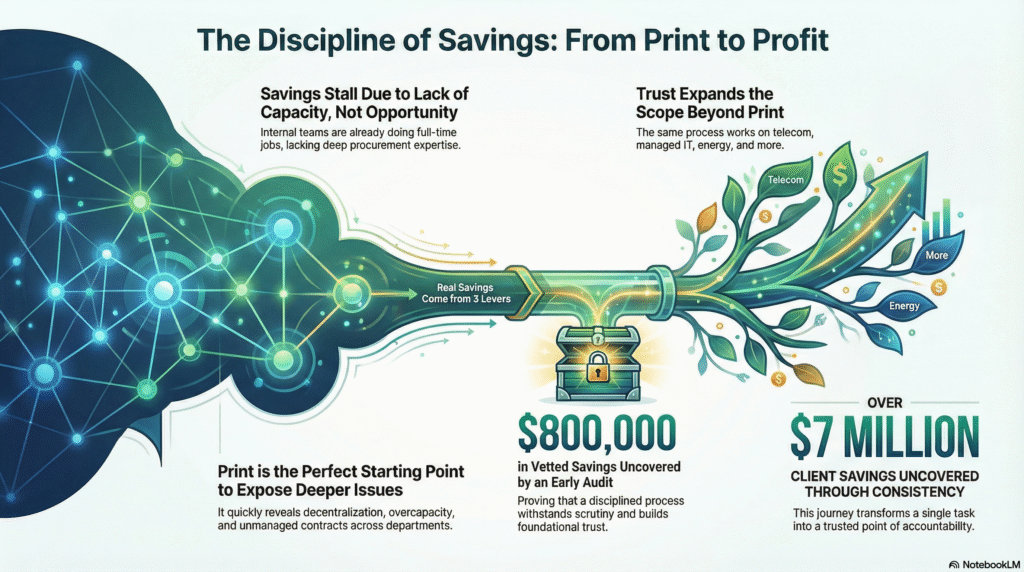
Most organizations already have savings available. The real blockers are time and industry knowledge, not opportunity. Our cost savings journey started with print/copiers because print quickly exposes decentralization, overcapacity, and unmanaged decisions. By applying deliberate, repeatable procurement processes, we earned trust, reduced effort for internal teams, and expanded savings across technology and operations without disruption or upfront cost.
Cost Savings Rarely Fail Because of Math
They fail because of capacity.
Most organizations are not blind to costs. In many cases, they are already negotiating, already benchmarking, already trying to be responsible. The problem is that procurement excellence is being treated like a side responsibility.
Lean teams are stretched thin. Finance, IT, and operations leaders are already doing full jobs. When you ask them to also be experts in purchasing, negotiation, contract design, and vendor economics, something gives. Usually it is depth.
That is where cost savings stall. Not because savings are unavailable, but because extracting them consistently takes time and category knowledge most teams do not have.
Why Printer/Copiers Reveal the Problem First
Our work in print began long before digital transformation buzzwords became popular. The promise of paperless offices has been around for decades. Here’s why it never fully materialized. Print is not about printers. It is about structure.
In larger organizations especially, print environments tend to be decentralized. Facilities teams manage single function printers scattered across offices. IT manages multifunction copiers with scanning, faxing, and finishing capabilities. No one owns the environment as a system.
When you start digging in, the same issues appear again and again.
There is overcapacity. Devices are built for peak usage that never happens. Features are paid for but rarely used. Auto ship toner programs are not truly usage based when examined closely. Contracts are renewed quietly because they feel low risk.
Print is often assumed to be handled. In reality, it is fragmented.
That fragmentation makes print the perfect starting point. It is visible, measurable, and non disruptive when addressed correctly.
Where Print Savings Actually Come From
There are three primary ways organizations save money in print. Each builds on the previous one.
First is rip and replace or renegotiation. This is the fastest and most obvious lever. Pricing improves, terms improve, and monthly spend drops.
Second is right sizing devices to the actual environment over a three to five year term. This is where structural savings begin. Devices match real usage, not assumptions.
Third is stripping devices down to what is actually being used. This is often invisible without a physical and operational audit.
We once revisited a client after an initial optimization cycle and saved an additional $50,000 simply by identifying stapling features no one knew they were paying for. The proof was simple. We pulled the staple cartridges and none had been used.
That type of savings does not come from theory. It comes from process and attention.
The First Breakthrough That Changed Everything
Early on, we did not have a name or recognition. We were asking clients to take a leap of faith.
One of our first major engagements was with a medical nonprofit in the Northeast. The decision maker liked the entrepreneurial spirit and gave us a shot. We made a decision we do not typically make now. Instead of waiting to optimize over time, we remediated immediately.
In doing so, we uncovered $800,000 in savings.
The client had their CPA audit our audit. That process took four months. When it was finished, the savings stood.
That moment mattered because it validated something important. A disciplined process can withstand scrutiny, even when trust is still forming.
Process Before Scale
From the beginning, everything was built around process.
Every engagement starts with an intake focused on organizational goals, not just invoices. We inventory devices, contracts, and usage. We benchmark. We ask hard questions early.
Time is our most valuable resource. If an organization has already done an excellent job, we are comfortable saying so. We do not want to create work where material savings do not exist.
When we do move forward, we take the lift off the client. Letters of authorization and intent allow us to gather data directly. We present options rather than prescriptions.
Some clients want a full rip and replace. Others want consolidation. Others want a stripped down efficiency model that delivers maximum savings over time.
The point is choice, backed by facts.
The Trust Moment We Almost Missed
After saving a client well over a million dollars, I expected the conversation to naturally expand. It did not.
Instead, the client asked me to read ‘Getting Everything You Can Out of All You’ve Got’ (highly recommended by the way!) One of the core takeaways was this. If you have a skill set that consistently produces better outcomes, you have a moral and ethical obligation to let people know about it; especially your existing clients!
When I finally raised the topic, the response was simple and honest.
I thought you just dealt in print.
That was the moment everything changed. Not because our capability was new, but because our clarity was.
Why Expansion Beyond Print Was Natural
Once trust was established, the next categories were obvious.
Connectivity, telecom, and managed IT sit at the intersection of finance and IT. They are commoditized, contract heavy, and full of quiet inefficiencies. The same procurement discipline that works in print works here too.
Over time, the scope expanded further. Energy solutions, waste, cybersecurity, MSP and MSSP services, penetration testing, translation and transcription.
We do not do this alone. We partner extensively, including with other cost reduction firms. The value is not pretending to know everything. It is knowing how to evaluate, govern, and hold vendors accountable.
From One Category to a Trusted Point of Contact
Some clients start small and stay small. That is fine.
We worked with a law firm that initially had one device. We saved them about $12,000, roughly 30 to 35 percent. Over time, the firm grew to multiple locations with seven devices. Then came networking, internet, phone systems, and document management.
The outcome was not just savings. It was simplicity.
When something came up, the response became call Dan.
That is the real delta. One point of accountability, informed by real implementation experience, not theory.
What Deliberate and Scalable Actually Look Like
Deliberate means we do the lifting, not the client.
Predictable means we know where vendors hide margin and risk.
Reliable means we answer the phone.
Consistent means the same cadence and rigor every time.
Scalable means the process works for a five person office or a 3,500 employee organization.
Procurement is not an event. It is an act of consistency.
Through that consistency, we have helped uncover more than $7 million in savings across very different areas of the business.
Why This Matters Now
Today, nearly every leader will tell you there are not enough hours in the day. They are already raising both hands.
Yet we still expect internal teams to master procurement, negotiation, contract design, and vendor economics on top of everything else. That expectation is no longer realistic.
Performance based cost reduction changes the equation. If you are paying your bills today, it is already affordable. There is no large upfront spend. No major disruption. No capex shock.
In many cases, the real risk is continuing without governance.
Going into 2026 and beyond, this is not a nice to have. It is a capability organizations cannot afford to be without.
DEBottomLine
Our cost savings journey started with ambition and lots of discipline.
Print was not small. It was revealing. Process built trust. Trust expanded scope. And consistency compounded results.
Start with one category. Build a system. Let outcomes do the rest.