How Letters of Authorization (LOAs) and Letters of Intent (LOIs) Remove Bottlenecks

Most organizations do not avoid cost reduction because they doubt the opportunity.
They avoid it because of the perceived effort.
The concern is rarely “Are savings possible?”
It is almost always “How much work will this create for my team?”
In lean organizations—where finance, IT, and operations already operate at capacity—any initiative that introduces vendor coordination, document retrieval, contract review, or renewal management feels disruptive before it even begins.
That is precisely the problem Letters of Authorization (LOAs) and Letters of Intent (LOIs) are designed to solve.
The Real Bottleneck Isn’t Savings — It’s Bandwidth
Executives generally understand three things:
- Legacy technology costs tend to accumulate quietly over time
- Vendors rarely self-correct billing or contract inefficiencies
- Internal teams do not have the time to continuously audit every spend category
What prevents action is not skepticism about savings.
It is concern about operational drag.
In fact, there are many scenarios where leading with savings is the wrong move altogether. In high-risk categories like internet infrastructure and cybersecurity, performance, resilience, and continuity often matter more than short-term cost reduction.
Understanding the real pros and cons of cost reduction helps organizations identify where savings create strength and where they can introduce operational or financial risk.
Questions we hear repeatedly:
- Who will gather the contracts?
- Who will chase vendors?
- Who owns the renewal timelines?
- Who manages the back-and-forth?
This is precisely why technology expense management has evolved into an ongoing governance discipline rather than a one-time project. Without dedicated oversight, obsolete services, missed renewals, and billing errors persist—not because organizations are careless, but because they are lean by design.
What a Letter of Authorization Actually Does
A Letter of Authorization (LOA) is not about giving up control.
It is about removing administrative friction.
When properly structured, an LOA allows a cost reduction partner to act as an extension of the organization—without adding cost, risk, or obligation.
With an LOA in place, we are authorized to:
- Request invoices, contracts, and historical billing directly from vendors
- Retrieve original agreements, amendments, SLAs, and renewal terms
- Submit notices, including non-renewals and cancellations, where applicable
- Engage vendors directly to validate data and correct discrepancies
Just as important, there are clear limitations:
- No authority to add services
- No authority to add cost
- No authority to financially bind the client
The intent is narrow, even if the access is broad:
lower costs, eliminate waste, and prevent avoidable renewals.
True efficiency in business comes from governance and predictability, not reactive decisions.
Why This Matters More Than Most Organizations Realize
The most expensive cost mistakes are rarely about bad decisions.
They are about missed deadlines.
Many contracts require notice windows—often 90 to 180 days before expiration. Miss that window, and the agreement may automatically renew for another year or longer. At that point:
- Competitive bids lose leverage
- Buyouts distort pricing comparisons
- Savings opportunities evaporate
LOAs allow this work to happen in parallel with day-to-day operations, without relying on internal reminders, calendar tracking, or last-minute scrambles.
Letters of Intent: Preventing the Second Bottleneck

A Letter of Intent (LOI) is often misunderstood.
In cost reduction engagements, LOIs are most commonly used to:
- Signal non-renewal intent early
- Preserve optionality
- Prevent evergreen extensions
- Avoid unnecessary internal escalation
An LOI is not a contract.
It does not lock pricing.
It does not commit inventory.
It simply prevents avoidable problems later—especially the familiar scenario where savings are identified, momentum exists, and then progress stalls because someone needs to draft or approve a formal notice.
In many cases, LOAs allow us to submit LOIs on behalf of the client, eliminating yet another handoff.
Vendor Behavior Changes — And That’s Not a Bad Thing
When a third-party cost reduction firm enters the picture with formal authorization, vendor behavior tends to shift.
Not dramatically—but noticeably.
- Responses become more precise
- Documentation improves
- Inconsistencies surface faster
- Prior “summary views” can be reconciled against raw data
This is not adversarial. It is accountability.
When discrepancies appear between what was previously presented and what the data actually shows, those conversations become factual, not emotional. That clarity benefits everyone.
Similar outcomes can be seen across industries in our cost reduction case studies, where clients achieved meaningful savings with minimal internal effort.
A Real-World Example: Zero Lift, Real Results
In one long-standing client relationship, an LOA was structured to remain active for 18 months. The reason was simple:
- Some contracts were mid-term
- Others were approaching renewal
- All required coordinated oversight
The client’s involvement was minimal:
- One initial conversation to confirm objectives
- Periodic confirmation if needs changed
Everything else—document retrieval, renewal tracking, vendor communication, non-renewal submissions—was handled externally.
Because the data came directly from the incumbent vendors, the resulting analysis was defensible, accurate, and actionable. No internal scramble. No missed deadlines.
Where This Model Does Not Cross the Line
Cost reduction is fundamentally an exercise in trust.
That trust only works if boundaries are clear.
Even with authorization, there are lines that should never be crossed:
- No actions outside documented authority
- No opaque tactics
- No behavior that risks long-term vendor relationships unnecessarily
- No shortcuts that compromise credibility
Reputation matters—especially in industries where trust is built over years and lost in moments.
How Much Effort Does This Actually Save?
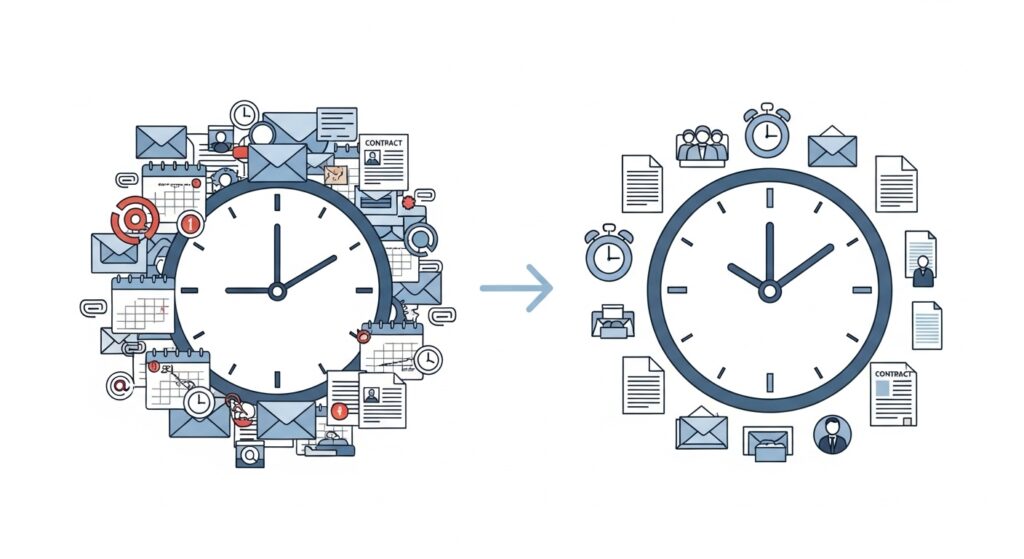
Compared to a DIY audit or broker-led review, organizations routinely avoid:
- Countless vendor emails
- Multiple recurring meetings through a multitude of vendors
- Manual contract hunting
- Calendar management for renewal windows
Depending on scope, this can conservatively represent 40 to 100+ internal hours saved—often more in complex environments.
That time stays focused on operations, not administrative cleanup.
Cost Reduction Should Not Require Heroics
One final point often overlooked:
Even when savings are identified, organizations worry about how they are paid for.
Many organizations are surprised to learn that our work is delivered through a performance-based cost reduction model, where fees align with savings realized over time rather than upfront capital outlay.
A performance-based, operating-expense (OPEX) model matters here. When savings are realized over time, fees are aligned accordingly—measured, predictable, and digestible.
How do you eat an elephant?
One bite at a time.
The Bottom Line
Cost reduction should not be avoided because it sounds hard.
With the right structure, it is not.
LOAs and LOIs exist to:
- Remove bottlenecks
- Protect timelines
- Reduce internal effort
- Preserve control
When used correctly, they allow organizations to pursue meaningful savings without disrupting the people responsible for running the business.
And that is the point.