Copier Leases & Print Cost Reduction
How to Negotiate a Copier Contract: 6 Ways to Save Money
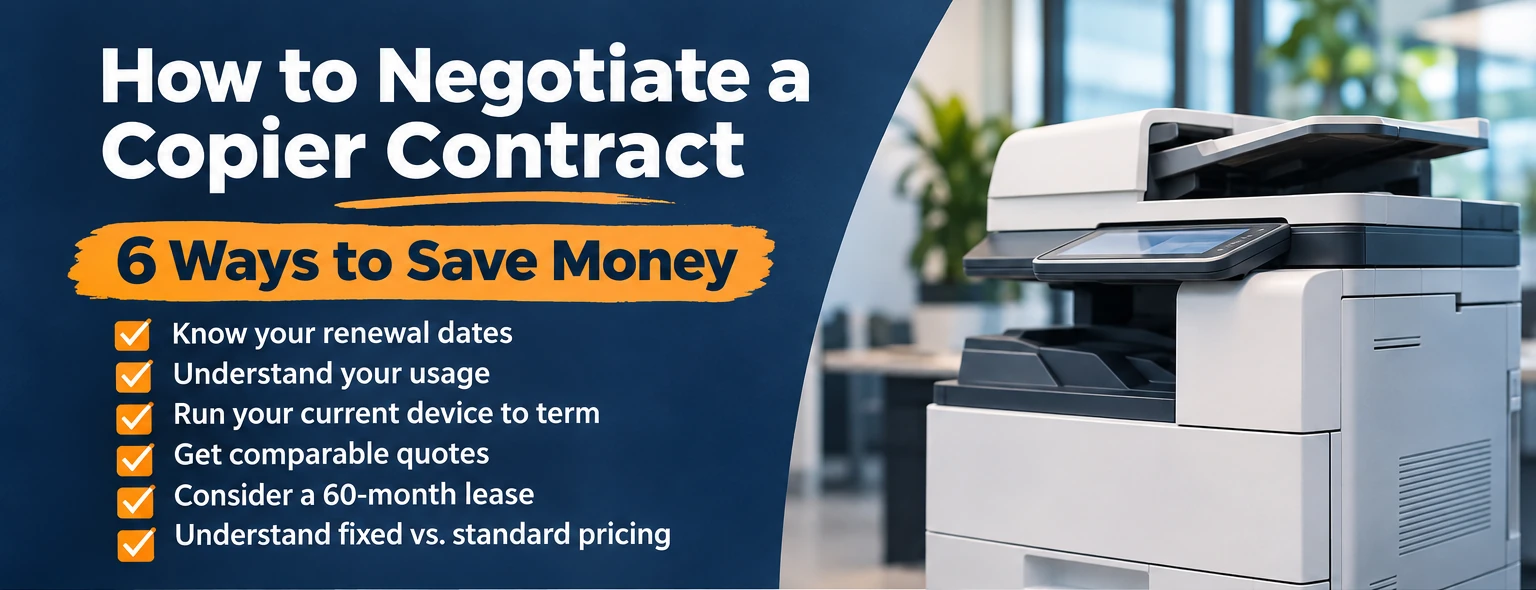
Can you negotiate your own copier contract? Absolutely.
Anyone can negotiate a copier lease. You don't need to be an expert, and you don't need to hire someone to do it for you.
But getting a good deal takes more than asking your copier company for a lower price.
You need to know when your contract ends, how much you're printing, what other companies charge, and what the fine print actually means.
And, of course, you need the time to do all of that.
Here are six things I'd look at before negotiating your next copier contract.
1. Know When Your Copier Contract Renews
Before you negotiate anything, find out when your current agreement ends.
Then find something even more important.
When do you have to tell your copier company that you don't want to renew?
Many copier contracts automatically renew unless you give written notice by a certain date.
Miss that deadline, and you could find yourself paying for equipment longer than you planned.
Here's what you need to check:
- Your lease expiration date.
- Your automatic renewal terms.
- How much notice you need to give.
- How that notice must be delivered.
I recommend starting the process at least six months before your lease expires, while also checking whether your notice deadline comes earlier.
And remember, giving notice doesn't mean you have to leave your current vendor.
It simply protects your options.
We helped a nonprofit organization facing a copier renewal reduce its costs by 25%. The project involved renewal deadlines, billing mistakes, and a proposed equipment upgrade that would have increased costs.
Read how we helped the nonprofit negotiate a better copier agreement.
The lesson? Know your dates before your vendor controls the clock.
For more on protecting yourself before a renewal, see our Vendor Contract Negotiation services.
2. Understand How Much You're Actually Printing
Here's something that happens all the time.
A business signs a copier contract based on how much it expects to print.
Five years later, it's printing far less.
But it's still paying for the same equipment and services.
Sound familiar?
Before negotiating, review your last 12 months of printing.
Find out:
- How many black-and-white pages you print.
- How many color pages you print.
- Which machines get used the most.
- Whether you're paying for pages you don't use.
- Whether you have more machines than you need.
Let's say your business used to print 10,000 pages per month.
Now you're only printing 4,000.
Do you really need the same equipment and printing plan?
Probably not.
We worked with a nonprofit healthcare organization that had 50 copiers, 120 printers, and 12 different leases.
After reviewing the equipment and what people actually needed, we helped reduce the fleet to 47 copiers and 44 printers under one agreement.
The result? An 83.45% reduction in print costs.
See how we reduced this healthcare organization's printing costs.
Don't negotiate based on what you used to need. Negotiate based on what you need today.
3. Whenever Practical, Let Your Current Copier Lease Run to Term
Your copier salesperson calls with an offer.
A brand-new machine and a lower monthly payment.
Sounds great, right?
But there's one thing you need to ask:
What happens to the payments you still owe on your current copier?
If you have 18 months remaining on your lease, those payments don't just disappear.
In many cases, the remaining balance gets rolled into your new agreement.
You may be paying less each month, but you've also started another five-year contract while carrying the cost of your old machine.
That's why I generally recommend running your existing copier to the end of its lease, assuming it's still working well.
Of course, if your equipment is constantly breaking down or your needs have changed, replacing it early might make sense.
Just make sure you understand the old balance, the new agreement, and the full cost of the change.
The goal isn't just a lower monthly payment. It's to avoid paying for equipment you no longer use.
4. Get Multiple Quotes, But Compare the Same Things
Getting three copier quotes sounds like a great idea.
And it is.
But only if you're comparing the same things.
Imagine this:
One company quotes you $300 per month.
Another quotes $400.
And a third quotes $350.
Who's giving you the best deal?
You have no idea.
One might include more printing. Another might include better equipment. The cheapest option might have higher service costs.
To make a fair comparison, ask vendors to quote the same basic requirements.
Compare:
- Equipment features and printing speed.
- Lease length.
- Monthly equipment costs.
- Black-and-white and color printing rates.
- Maintenance, repairs, and toner.
- Annual price increases.
- Other fees and contract terms.
Once you're comparing the same things, you can see which offer is actually better.
Here's another thing worth remembering.
Your current vendor should get a chance to compete, too.
You might love your copier company. Their service is great. Their technicians know your business.
That's fine.
You don't need to leave them just because someone else offers a lower price.
Sometimes showing your existing vendor what the market looks like is enough to get a much better deal.
This is also why we start with a review of your current bills and contracts through our Technology Expense Audit process.

Like Your Copier Vendor? Keep Them. Pay Less.
We've saved clients millions on print contracts, often without requiring them to change vendors.
We review your contracts, compare the numbers, and handle the negotiation.
See How We Reduce Print Costs5. Don't Be Afraid of a 60-Month Copier Lease
You'll find plenty of advice telling you to avoid long copier leases.
I don't necessarily agree.
In my experience, more than 99% of the clients I've worked with have chosen 60-month leases or longer.
And for many businesses, that's perfectly fine.
Why?
Because spreading the equipment cost over more months can lower your monthly payment.
If you're not putting your copier through extremely heavy use, and your printing needs aren't likely to change much, a five-year agreement can make sense.
Think about it.
If your copier works great after three years, why replace it just because it's three years old?
Of course, there's a tradeoff.
A longer lease usually means a longer commitment. And if you need to get out early, that can get expensive.
So don't choose a 60-month lease just because the payment looks better.
Make sure the equipment will last, the service is dependable, and the agreement makes sense for your business.
The goal isn't the shortest lease. It's the right equipment, at the right price, for the right amount of time.
6. Understand Fixed Pricing vs. Standard Pricing
Here's where copier contracts can get expensive without you noticing.
Your monthly equipment payment might stay the same for five years.
But your service costs?
Those could increase every year.
Let's say your copier service starts at $500 per month.
Your contract allows a 10% annual increase.
Here's what happens:
| Year | Monthly Service Cost |
|---|---|
| Year 1 | $500.00 |
| Year 2 | $550.00 |
| Year 3 | $605.00 |
| Year 4 | $665.50 |
| Year 5 | $732.05 |
By year five, you're paying over 46% more per month than when you started.
For the same starting level of service.
That's why it's important to understand fixed pricing versus standard pricing.
Fixed pricing generally means your agreed service rates stay the same for a set period.
Standard pricing may allow increases during the contract.
The exact meaning depends on the provider and the agreement.
Before signing, ask:
- Will my black-and-white printing rates increase?
- Will my color printing rates increase?
- Is there a limit on annual increases?
- Can we lock in service pricing for the entire term?
Even a small increase can become expensive when you're printing thousands of pages every month.
Don't just negotiate what you'll pay today. Know what you'll pay five years from now.
Three More Things Most People Don't Consider
Those six steps will put you in a much better position to negotiate.
But there are a few other things worth considering before signing.
Do You Really Need a Brand-New Copier?
Not always.
Used or refurbished equipment can be a great way to lower costs.
If you're not printing huge volumes, a properly maintained refurbished copier might do everything you need for much less money.
Just make sure you understand its age, meter count, condition, parts availability, warranty, and service coverage.
Newer doesn't always mean better for your business.
What Happens When Your Copier Breaks?
Everyone looks at price.
Not everyone looks at service.
But what good is a cheap copier if it breaks down and nobody comes to fix it?
That's where an SLA, or Service Level Agreement, comes in.
It's simply a written promise about the service your copier company will provide.
Before signing, ask:
- How quickly will someone respond when the copier breaks?
- How soon can a technician come out?
- What happens if the machine can't be fixed?
- Will you get a replacement or loaner?
- What happens if the vendor repeatedly misses its service promises?
Make sure those promises are in writing.
How Much Does the Lease Rate Affect Your Payment?
More than most people realize.
When you lease a copier, you're not just paying for the machine.
You're also paying to finance it.
Two vendors could offer the exact same copier at the exact same equipment price, but the monthly payments could be different because they're using different lease rates.
For example, imagine two quotes for the same copier over 60 months.
One costs $300 per month.
The other costs $325.
That's a $25 difference.
Over five years, that's $1,500 more for the same equipment.
Before signing, ask for the equipment price, monthly lease payment, contract terms, and end-of-lease purchase or return options.
If possible, ask for a cash purchase price too.
You want to understand what the machine costs and what you're paying to finance it.
Common Questions About Copier Contract Negotiation
Can You Negotiate a Copier Lease?
Yes. Equipment price, service rates, printing allowances, annual increases, and contract terms may all be negotiable before you sign. Existing lease payments are usually harder to change.
When Should You Start Negotiating a Copier Contract?
I recommend starting around six months before your lease expires. Check your current agreement for any earlier notice deadlines.
Is a 60-Month Copier Lease a Bad Idea?
Not necessarily. A five-year lease can lower the monthly equipment payment, but it also means a longer commitment. The right term depends on your equipment, usage, and business needs.
Can You Negotiate With Your Existing Copier Vendor?
Absolutely. You don't necessarily need to switch providers to get better pricing. Your current vendor may be willing to negotiate when you understand your usage and have comparable quotes.
Can You Negotiate a Copier Contract Before It Expires?
Yes. You can ask to change service pricing, printing allowances, or other terms. Whether your vendor agrees depends on your contract and the remaining obligations.
Anyone Can Negotiate a Copier Contract. But Who Has the Time?
Here's the part most businesses struggle with.
None of this is especially difficult to understand.
But doing it takes time.
You have to find agreements, review invoices, collect printing reports, get quotes, compare equipment, and negotiate with salespeople.
All while doing your actual job.
And that's exactly why DE Bottom Line exists.
We handle the heavy lifting.
We review your contracts, study your printing needs, compare pricing, negotiate better terms, and help put the savings in place.
We've saved clients millions of dollars on copier and print contracts, often without requiring them to leave the vendors they already like.
Sometimes the best outcome isn't a new vendor.
It's keeping the one you already trust, just at a much better price.

You Run Your Business. We'll Handle the Copier Contract.
If you enjoy reviewing contracts, comparing quotes, and spending hours negotiating with salespeople, you now know where to start.
But if you're like most people, you've got better things to do.
Let us handle the work and find out whether there's room to reduce your copier costs.
Schedule a ConversationCome for the savings. Stay for the experience.
...and that's DE Bottom Line.