TLDR
Cost reduction works when it focuses on recurring spend, real usage, and contract terms. The biggest benefits are long term savings, better vendor accountability, and minimal internal workload when handled correctly. The biggest risks happen when companies rush, treat cost reduction like a checklist task, or cut critical infrastructure instead of optimizing it. Done right, cost reduction should feel operationally invisible and financially obvious. The only thing you should notice is improved profitability and stronger financial control.
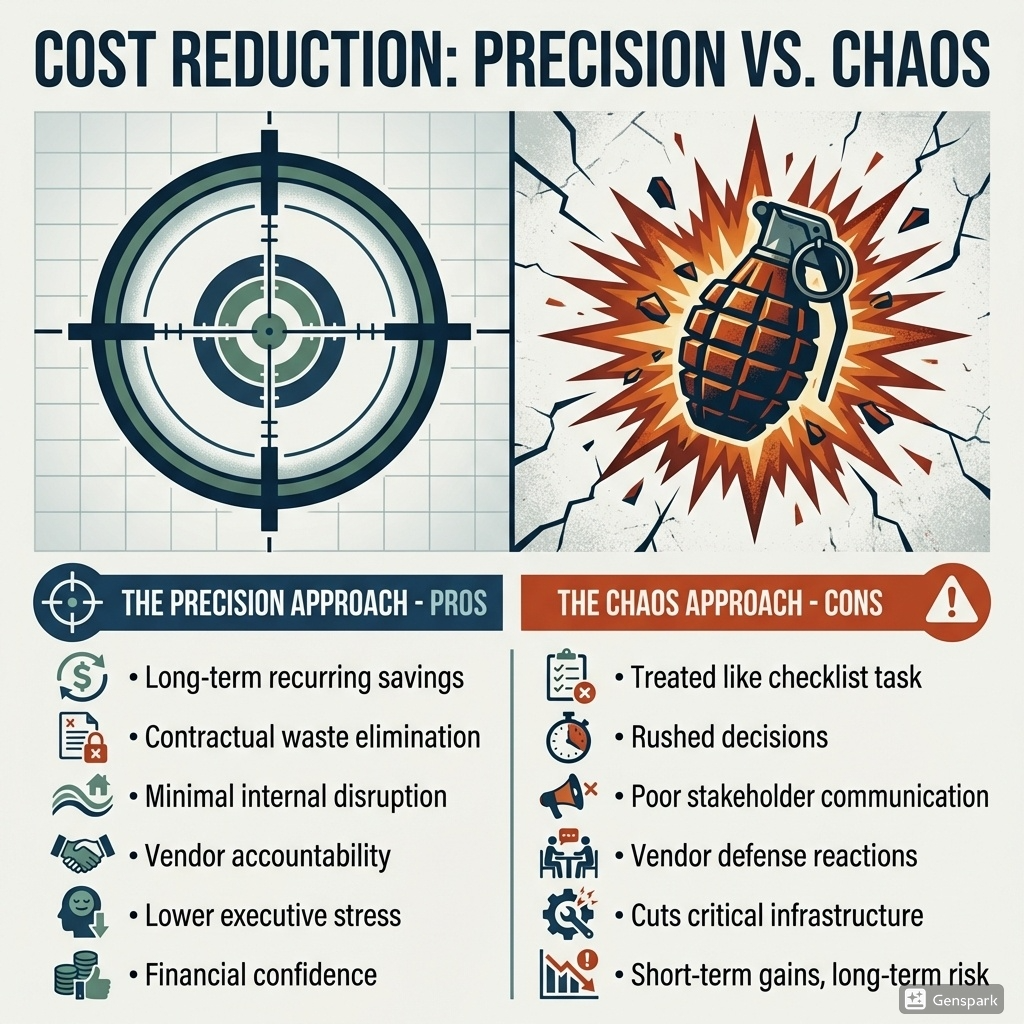
Pros and Cons of Cost Reduction: What Actually Works in the Real World
Most organizations think cost reduction means cutting spend quickly. In reality, effective cost reduction is about aligning spend with actual business need and contract value.
The difference between successful cost reduction and failed cost reduction is rarely effort. It is almost always approach, timing, and execution ownership.
What Cost Reduction Really Means (And What It Does Not)
Cost reduction is not cutting budgets quickly.
Cost reduction is aligning what you pay with what you actually use and need.
Cost Reduction vs Cost Cutting
Cost cutting is reactive.
Cost reduction is intentional.
Cost cutting often shows up as:
- Hiring freezes
- Tool cancellations without analysis
- Vendor changes driven by price only
Cost reduction shows up as:
- Contract optimization
- Usage alignment
- Vendor accountability
- Long term financial improvement
Why Most Organizations Misunderstand Cost Reduction
The biggest mistake companies make is trying to do it alone.
In almost every other function, companies bring in expertise. Marketing. Legal. Security. Infrastructure. But cost reduction is often treated like something internal teams should figure out on top of their existing workload.
In many cases, the real barrier is not effort but decision bias. Organizations often default to familiar vendors or assume previous negotiations already produced the best result. We explore this deeper in our article on consulting bias and why it quietly derails business decisions.
The Pros of Cost Reduction When Done Correctly
Long Term Recurring Financial Gains
One of the largest savings we personally validated was a startup in Northern California paying an MSP roughly $27,000 per month for technology they were not using. Multiple project management tools. Duplicate systems. ERP functionality that was never implemented.
This was not fraud. It was chaos. Startup environments move fast. Spend accumulates faster.
Savings like this compound across contract terms.
Minimal Internal Workload When Execution Is Handled Properly
The biggest fear executives have is this turning into another internal project. When cost reduction is executed correctly, the lift sits with the firm running the engagement.
From contract signing through LOA collection, contract gathering, roadmap creation, and vendor coordination, the goal is minimal disruption to finance, accounting, and operations teams.
Vendor Accountability Improves
Most vendors are not actively trying to overcharge. But vendors do respond to pressure and visibility. When benchmarking, contract review, and usage validation happen consistently, vendor performance improves.
Interestingly, about 85 percent of engagements end with the client staying with their incumbent vendor. The difference is the pricing and structure are corrected.
Executive Confidence Improves
Cost reduction is not just financial. It is emotional.
Many owners and executives built their organizations from nothing or operate multi generation businesses. Removing uncertainty around spend reduces stress and increases confidence in financial planning.
The Cons and Risks of Cost Reduction When Done Poorly
Short Term Savings That Create Long Term Risk
If cost reduction is treated like a checklist item, it usually fails. Rushed decisions create fragile vendor environments and hidden risk.
Vendor Revenue Protection Behavior
A common vendor reaction is attempting to go around the cost reduction partner. They may suggest the client can avoid fees or offer direct pricing changes.
This is usually driven by fear of margin compression, not malicious intent. But it can create confusion and break project momentum.
Internal Resistance and Communication Breakdowns
Cost reduction requires open communication. If stakeholders are not aligned, projects stall or lose credibility internally.
Cutting Critical Infrastructure Instead of Optimizing It
There are areas where cost reduction should shift into cost optimization. Network infrastructure, security, and production critical systems often fall into this category.
The goal is financial efficiency, not operational risk.
Why Cost Reduction Projects Fail More Often Than They Should
The most common failure patterns are:
No benchmarking against real market pricing
Wrong stakeholder mapping
Lack of internal communication
DIY cost reduction without market intelligence
Real World Cost Reduction Patterns
Hidden spend can exist for years. Sometimes decades.
We recently completed a telecom expense review where legacy services had existed for over ten years. Ninety percent of those lines had not been used in at least a year.
This is not unusual. It is structural. Modern organizations are complex and move fast.
How to Approach Cost Reduction Without Creating Operational Risk
Treat cost reduction as a defined project
Map stakeholders early
Align vendor communication strategy
Focus on recurring spend first
Monitor savings after implementation
DEBottomLine
When cost reduction is done correctly, the only thing leadership should notice is improved profitability and better financial control.
You should not be dealing with operational chaos.
You should not be managing extra workload.
You should not be fighting vendors.
You should see:
More margin
More budget flexibility
More financial confidence