The Spend You Don’t See Is the One Hurting You Most
Why Obsolete Technology Costs Persist — and Why Technology Expense Management Is Now a Leadership Imperative
Most executives believe their organization has reasonable control over operating expenses. Budgets are approved. Variances are monitored. Trusted vendors are in place. Nothing appears materially wrong.
And yet, across industries — particularly in lean, regulated environments — material technology spend continues quietly for years on services that are no longer used, no longer required, and in some cases no longer functional.
Not because of negligence.
Because modern organizations are structurally vulnerable to it.
Approved, Paid, and Operationally Obsolete
During a proactive, segment-by-segment technology expense review initiated by D.E. Bottom Line Consulting, the telecom environment exposed a significant blind spot: legacy POTS (Plain Old Telephone Service) lines that had quietly outlived their purpose.
What made this discovery troubling was not its existence — but how long it had persisted.
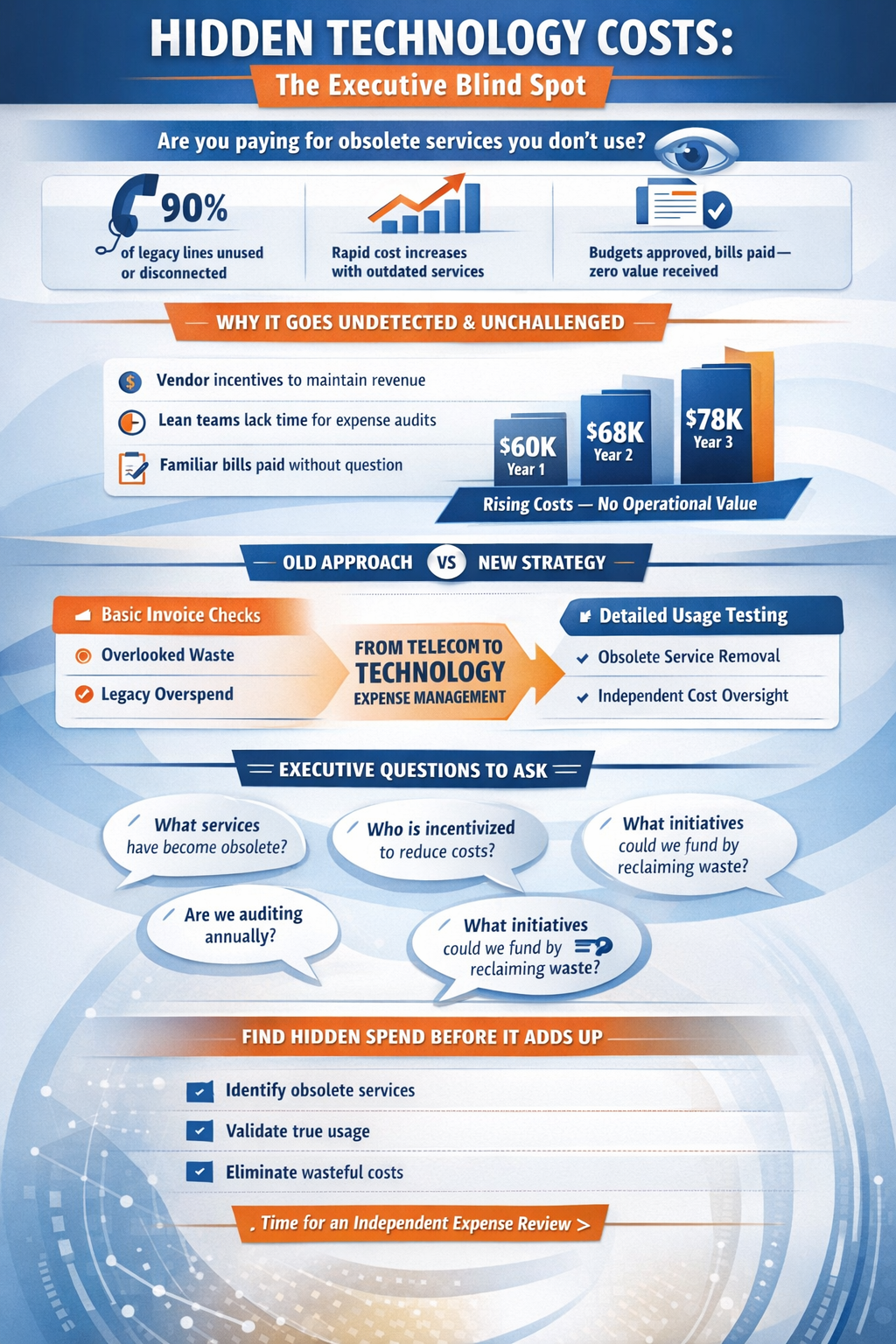
- Nearly 90% of the lines tested were not in use, disconnected, or rang indefinitely
- Many had not been used in years
- Pricing had increased rapidly as carriers accelerated copper network decommissioning, further increasing costs for legacy services that no longer delivered value.
- The spend was fully approved, budgeted, and paid — yet provided no operational value
Nothing had “broken.” There were no outages. No alerts. No invoice anomalies — aside from steady price escalation.
This is how obsolete spend survives.
The Incentive Misalignment That Enables Waste

When organizations uncover this type of waste, a natural question follows:
“Why didn’t our partner identify this?”
The answer is uncomfortable, but critical.
In this case, the existing broker agent was compensated as a percentage of monthly carrier spend, while the carrier continued to earn recurring revenue on every active line.
…No party involved benefited from reducing the bill. This is precisely why organizations turn to independent, performance-based cost reduction services that are incentivized to eliminate waste rather than preserve it.
Expecting vendors or broker partners to aggressively audit and eliminate services that directly reduce their own revenue is unrealistic — particularly in environments governed by growth targets or shareholder expectations.
This is not misconduct.
It is structural misalignment.
And it is why obsolete services are more likely to be renewed than questioned.
Why the Problem Is Getting Worse — Not Better

This issue is accelerating, not diminishing.
Organizations today are running leaner than ever. IT and finance teams are asked to do more with fewer resources. Governance frameworks exist, but real-world execution is constrained by time, data fragmentation, and competing priorities. These constraints are well documented across industries, particularly in discussions around technology spend governance and cost accountability. This is also why the status quo vendor costs more over time—because commoditized services are treated as “set and forget,” and without benchmarking, last year’s bill quietly becomes the only reference point.
Even well-run organizations lack the structure and tooling required for optimizing IT and telecom expenses across rapidly changing environments.
- Enough eyes on every spend category
- The bandwidth to test services for actual usage
- Independent parties incentivized to challenge assumptions
Technology environments evolve faster than governance processes. Services become obsolete quietly. Bills continue to be paid automatically. Budget lines persist year over year.
The false assumption most executives still hold is simple:
“This category is under control.”
In reality, “under control” often means unchallenged.
From Telecom Expense Management to Technology Expense Management
Traditional Telecom Expense Management was designed to validate invoices — not question relevance.
That model no longer works.
Uncovering the truth in this case required:
- Detailed usage reports
- Letters of Authorization to speak directly with carriers
- Line-by-line and DID-by-DID testing, conducted on multiple occasions
- Stakeholder validation before any cancellations were executed
This is not invoice management.
This is Technology Expense Management — a broader discipline focused on identifying billing errors, detecting anomalies, validating real usage, and determining whether spend is still justified at all.
Organizations often struggle not because cost reduction is impossible, but because it is approached incorrectly. The practical do’s and don’ts of cost reduction determine whether savings create control—or introduce new problems.
Just as important, cost reduction is not always the first objective. In high-risk categories, performance, resilience, and continuity often need to be addressed before cost reduction becomes the primary focus.
The Financial Impact of Inaction
Had this gone undiscovered, the financial trajectory was clear.
- Annual spend would have increased from approximately $60,000 to $68,000 within 12 months
- Within 24 months, that figure would have exceeded $78,000 annually
- All for services delivering no operational value
When the organization eventually pursued a strategic initiative, those dollars would have been pulled from reserves or incremental budget approvals — rather than reclaimed from waste.
Instead, the recovered savings were immediately reallocated to fund a long-standing technology initiative without additional approvals, disruption, or staffing changes.
This is the difference between cost cutting and capital recovery.
The Human Reality: Relief, Not Blame
For IT leadership, the outcome was relief.
Lean teams are already stretched thin. Accountability without capacity is a recipe for burnout, not control. When independent help is offered — especially by a partner without conflicting incentives — the most productive response is not defensiveness, but action.
Finance leadership saw the broader pattern: small, familiar charges that felt immaterial individually had compounded into a material opportunity cost over time.
Out of sight had become out of mind.
The Executive Question That Matters
This case is not exceptional. It is representative.
Executives should be asking:
- What services in our environment have quietly become obsolete?
- Who is incentivized to identify and eliminate that spend?
- Are we auditing technology expenses annually — or renewing them by default?
- What strategic initiatives could we fund today by reclaiming invisible waste?
In this case alone, the recovered spend equated to the cost of an FTE — achieved with minimal internal lift and no operational disruption.
Final Thought
The most dangerous expenses are not the ones debated every budget cycle.
They are the ones no one questions anymore.
In an era of accelerating technology change and shrinking internal resources, Technology Expense Management is no longer a tactical function. It is a governance requirement.
Organizations that recognize this will not only reduce costs — they will create capacity for what comes next.
If your technology environment has evolved faster than your contracts, invoices, and assumptions, there is likely spend in your organization that no longer serves a purpose. An independent review can surface what routine oversight often misses.