TL;DR
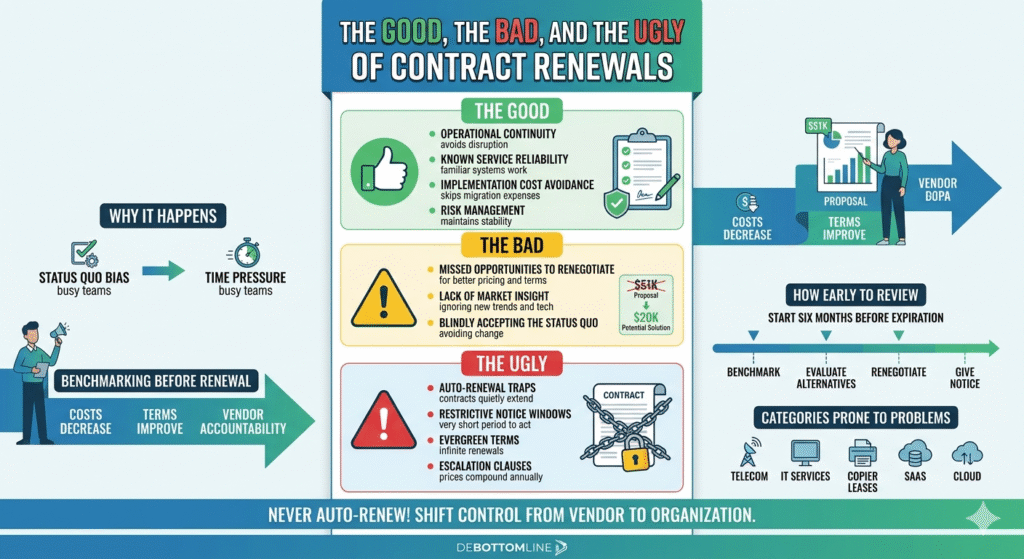
Contract renewals are one of the most overlooked drivers of overspending inside organizations. Renewals often happen automatically due to status quo bias, time pressure, and lack of benchmarking. The good is operational continuity. The bad is missed opportunities to renegotiate pricing and terms. The ugly is auto-renewals and restrictive clauses that quietly lock companies into outdated contracts. Organizations that benchmark their contracts before renewal consistently reduce costs while improving terms, service levels, and vendor accountability.
The Good, the Bad, and the Ugly of Contract Renewals
Most contracts do not end with a dramatic negotiation.
They quietly renew.
No one gathers in a conference room to celebrate a telecom contract extending for another three years. No executive sends a company-wide memo announcing that the copier lease has rolled over again.
Renewals often happen in the background. Someone receives a notice. Someone assumes the service is working fine. The team is busy. The contract renews.
Over time this creates one of the most consistent sources of unnecessary spending inside organizations.
Not because companies are careless.
Because human behavior favors the status quo.
Why Contract Renewals Get So Little Attention
Most organizations are not ignoring their costs intentionally. Finance, IT, and operations teams are usually operating at full capacity already. Many organizations lack formal contract lifecycle management, which means renewal dates and escalation clauses often go unnoticed until it is too late.
When a contract renewal approaches, the easiest decision is to keep things the same.
Service is working.
Switching vendors sounds disruptive.
The risk of change feels higher than the potential reward.
This is where bias enters the conversation.
Specifically, status quo bias. People naturally prefer keeping things the same rather than introducing uncertainty.
Vendors understand this dynamic extremely well.
Which is why many contracts are written to quietly extend unless someone actively stops them.
The Good: Why Renewals Exist
Contract renewals are not inherently bad. In many cases they serve a practical purpose.
Operational continuity
Changing vendors can disrupt operations. Infrastructure changes require planning, implementation, and training.
Known service reliability
When a service works well, organizations are understandably hesitant to disrupt it.
Implementation cost avoidance
Transitioning to a new vendor often involves migration costs, onboarding, or system changes.
Risk management
In areas like cybersecurity, connectivity, and infrastructure, stability often matters more than chasing small savings.
The problem is not renewal itself.
The problem is renewing without reviewing – explained further in our Do’s and Don’ts post.
The Bad: Missed Opportunities
When contracts renew without being reviewed, organizations often miss meaningful opportunities to improve both pricing and terms.
A simple example from one of our projects illustrates this clearly.
A client received renewal quotes totaling roughly $51,000.
After reviewing the contract structure and exploring alternatives, we identified a solution just under $20,000.
That difference was not the result of a dramatic technology change. It came from understanding the market and applying benchmarking.
This is the part many companies miss.
The market changes constantly. Vendor pricing evolves. Technology improves.
Contracts do not automatically adjust to reflect those changes.
Without benchmarking, organizations have no idea whether their pricing is competitive.
The Ugly: Auto-Renewals and Contract Traps
The most problematic renewal situations almost always involve contract traps.
These include:
Auto-renewal clauses
Contracts renew automatically unless notice is provided within a narrow window.
Notice windows
Many agreements require cancellation notices 60 to 180 days before expiration. On a five-year contract that means you have roughly five percent of the total contract period to act.
Evergreen terms
Some contracts renew indefinitely unless canceled.
Escalation clauses
Built-in annual price increases that quietly compound over time.
One organization we worked with in Northern California had every problematic clause imaginable.
Escalations.
Auto-renewals.
Evergreen terms.
After reviewing the contract structure and bringing the agreement to market, the organization ultimately saved approximately $250,000.
None of those savings would have been discovered if the contract simply rolled forward.
Bias and the Power of the Status Quo
Even when savings are obvious, companies often stick with the vendor they already have.
This is not irrational. It is human.
People tend to choose the devil they know versus the devil they do not know.
That is status quo bias in action.
We once worked with a client that had an opportunity to reduce costs by roughly 85 percent through a vendor change.
The organization chose to stay with the incumbent vendor.
Why?
Comfort with the existing relationship.
Confidence in service reliability.
The familiarity of the current environment.
Bias does not always lead to the wrong decision. But it does explain why so many contracts renew without serious evaluation.
What Benchmarking Actually Reveals
Benchmarking is one of the simplest ways to break the renewal cycle.
It answers three critical questions:
- Is the pricing competitive?
- Are the contract terms reasonable?
- Are there better options available in the market?
Benchmarking does not automatically mean switching vendors.
In many cases the incumbent vendor still wins.
But the pricing improves.
The terms improve.
And the customer gains leverage.
A recent client experienced exactly that situation. They had already been auto-renewed, which limited the vendors we could approach.
Even with that constraint, we were still able to secure approximately 30 percent savings compared to the renewal proposal they initially received.
The simple act of reviewing the contract changed the outcome.
Signs a Contract Has Not Been Benchmarked
The indicators are usually obvious once you know what to look for.
A common phrase we hear from clients is:
“We have been with them for twenty years.”
That sentence alone often tells the entire story.
Other indicators include:
- Pricing that increases 15 to 20 percent during renewal cycles
- Contracts that have rolled forward multiple times
- Escalation clauses that compound annually
- Services sized for an organization that no longer exists
When contracts remain untouched for long periods of time, they rarely stay aligned with the market.
How Early Should You Review a Contract?
In an ideal world, contracts should be reviewed every year.
Realistically, most organizations will not do that internally.
A more practical rule is to begin reviewing contracts six months before renewal.
This timeline provides enough runway to:
- benchmark pricing
- evaluate alternatives
- renegotiate terms
- submit a notice of non-renewal if necessary
Waiting until the last minute eliminates leverage.
Once the renewal window closes, the contract often resets and negotiating power disappears.
Where Renewal Mistakes Hide the Most Money
Some categories are especially prone to problematic renewals.
These include:
- telecom and connectivity
- managed IT services
- copier and print leases
- SaaS software subscriptions
- cloud infrastructure agreements
These services operate quietly in the background. Because they are essential and operationally stable, they are rarely revisited.
Which is exactly why they should be.
The Philosophy: Never Auto-Renew
If there is one guiding principle when it comes to contracts, it is simple.
Never auto-renew. Period.
If a contract must renew automatically, the best option is to move to month-to-month terms without escalators.
Auto-renewals shift control from the customer to the vendor.
Reviewing contracts restores that balance.
DEBottom Line
Contract renewals rarely feel urgent.
But over time they quietly shape the financial structure of an organization.
The companies that consistently make better decisions around renewals tend to do three things well:
They recognize bias.
They challenge the status quo.
And they rely on benchmarking before committing to another term.
Renewals should be a deliberate decision.
Not a default.