TLDR
Comparison steals joy when it is about identity, status, or keeping up with someone else.
In business purchasing, vendor benchmarking does the opposite. It creates clarity, leverage, and accountability.
Premium pricing does not automatically equal premium value.
If you are not benchmarking vendors annually against measurable performance metrics, you are likely overpaying quietly and consistently.
Now let’s unpack that.
The Brownie Test and the Psychology of Premium
We recently did a blind taste test at home.
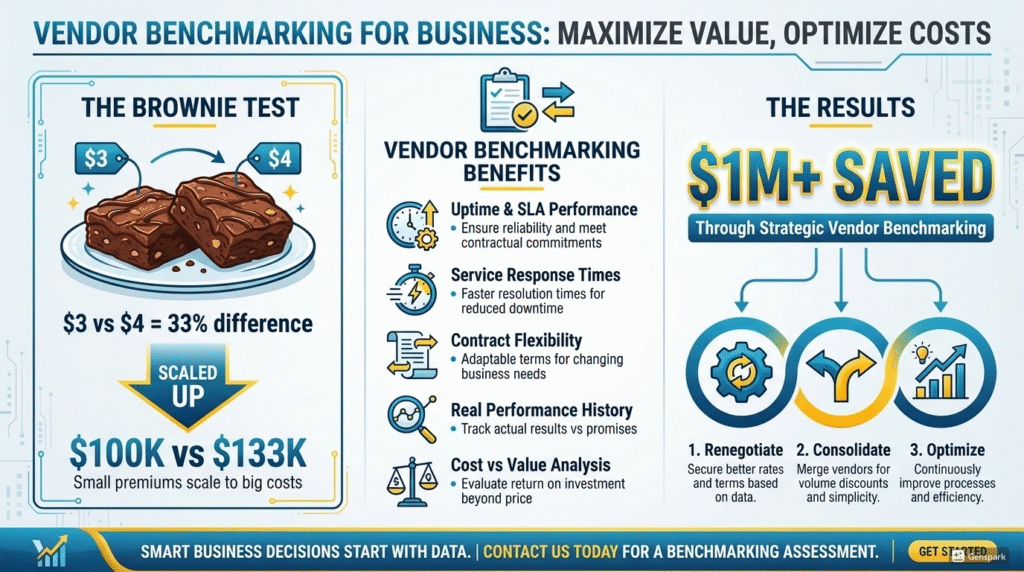
Two brownie brands. Betty Crocker and Ghirardelli. Roughly a 31% price difference. Three dollars and change versus four and change.
Five contestants. Three picked the premium. Two picked the lower priced option. No one changed their vote mid-test. My wife knew immediately which one was which. The kids did not care. They were satisfied either way.
Here is the part that matters.
At three versus four dollars, paying for premium feels harmless. It feels small. It feels easy to justify.
Scale that same difference.
Ten thousand versus thirteen thousand three hundred.
One hundred thousand versus one hundred thirty three thousand.
Now the premium decision deserves scrutiny.
Vendor benchmarking forces that scrutiny. It moves the conversation from emotion to evidence.

Where Comparison Steals Joy in Business
Earlier in my career in print, I watched seasoned reps with established accounts. It was easy for younger reps to talk about the veterans who had all the good territory and forget that they once started in the same place.
Over time, I watched mentors grow from ten employees to over one hundred. A decade later, you can compare who is bigger, faster, further along.
As a founder, comparison still shows up. Revenue numbers. Team size. Visibility in the market.
That kind of comparison drains energy. It shifts focus from execution to optics. It creates pressure that does not improve performance.
In identity and ego, comparison often steals joy.
In purchasing, it protects it.
Vendor Benchmarking Is Not Emotional. It Is Strategic.
Vendor benchmarking is simply disciplined comparison.
It is benchmarking vendors against measurable standards rather than brand perception. It is trust but verify.
When we run a vendor comparison process, we do not start with logos. We start with KPIs:
- Uptime commitments
- Service response times
- Technicians in the field
- SLA language
- Contract flexibility
- Real performance history
Once vendors are stripped of badges and scored objectively, the results often surprise leadership teams.
Across our client base, very few organizations select the most expensive option. They also rarely choose the absolute cheapest.
When decisions are driven by vendor benchmarking, the premium option frequently loses to the provider delivering the strongest measurable value.
A $1 Million Example of Vendor Benchmarking in Action
One of our largest clients has saved over one million dollars in print through structured vendor benchmarking.
The first engagement was simple. We renegotiated their existing contracts. Same equipment. Better pricing and terms.
They saw immediate savings.
The next phase involved consolidation. Fewer devices. Better utilization.
More savings.
The third phase focused on device reduction and operational efficiency. That created the most significant financial impact.
Each step required benchmarking vendors and comparing real performance against cost. Without that process, they would have renewed automatically and carried on with inflated contracts. All the while, they still are not paperless!
Vendor benchmarking created options they did not know they had.
Premium vs Value Purchasing in Real Contracts
Premium is not inherently wrong. It is contextual.
When Premium Was Not Worth It
In many vendor comparison processes, regional providers outperform national brands when scored purely on KPIs.
The badge carried weight. The numbers did not support it.
When vendor benchmarking removed the brand bias, the value shifted.
When Premium Is Worth It
Core infrastructure is different.
Redundancy can justify higher spend.
Security investments can justify higher spend.
Risk mitigation can justify higher spend.
Remember, there are areas where cost reduction isn’t priority.
But even here, vendor benchmarking matters.
SLAs are often marketed using fear. You may hear that an hour of downtime costs fifty thousand dollars. The financial credit for missing that SLA is usually a small fraction of one month’s bill.
Vendor benchmarking separates marketing language from operational reality.
Premium should be purchased with verified performance, not perception.
Vendor Benchmarking for Nonprofits and Foundations
Nonprofit vendor evaluation has its own pressures.
Sometimes vendor selection is influenced by foundation donations. The optics of giving back can overshadow the strength of the contract.
I have seen organizations overpay significantly while believing they were supporting their mission. In reality, they were financing their own donations through inflated vendor agreements.
Vendor benchmarking removes that bias.
It forces leadership to ask: Are we paying for performance, or are we paying for perception?
Nonprofits, like any business, benefit from benchmarking vendors annually to ensure mission dollars are not leaking through contracts.
Why Benchmarking Vendors Annually Protects Cash Flow
Technology evolves quickly.
There was a time when a computer filled a room and cost hundreds of thousands of dollars. Today, a device that fits on your desk outperforms it for a fraction of the cost.
Markets change. Vendor pricing does not always adjust at the same pace.
When you fail to benchmark vendors annually, you risk:
- Automatic renewals
- Quiet price creep
- Paying for unused features
- Carrying outdated pricing structures
Vendor benchmarking protects:
- Cash flow
- Performance standards
- Contract accountability
- Operational flexibility
Vendor loyalty is admirable. Blind renewal is expensive.
DEBottomLine: Mature Leaders Benchmark Vendors, Not Themselves
Comparison in life often drains energy.
Vendor benchmarking in business creates leverage.
You do not need to compare your revenue to someone else’s to operate well.
You do need to compare your vendors to the market.
Because premium might taste better or it might not.
At scale, that difference matters.