TL;DR
Most cost reduction consultants are built around pricing. We are built around outcomes.
Many firms will analyze your spend and give you recommendations. Then they leave. Others are tied to specific vendors, which introduces bias whether they admit it or not.
We take a different approach. We audit, validate, source, implement, and stay accountable after the deal is done.
The biggest constraint is not lack of savings. It is lack of time and expertise to extract them.
That is why clients come to us for savings, but they stay because we remove the effort and own the process.
Why Most Companies Don’t Seek Cost Reduction Consulting Until It’s Too Late

Most companies don’t wake up one day and decide to hire a cost reduction consultant.
In our experience, almost every engagement starts with a referral.
That matters because it means we are often stepping into environments where:
- Teams are already stretched thin
- Contracts have quietly renewed
- Vendors are entrenched
- Procurement has become reactive instead of strategic
The root issue is not carelessness. It is capacity.
When procurement becomes a side responsibility, optimization slows down. Over time, that creates inefficiencies that compound.
The Biggest Misconception About Cost Reduction Consulting
The most common misconception is that cost reduction is just rate shopping.
It is not. The industry itself is fragmented, and not all firms operate the same way. Broadly speaking, you will run into a few types:
- Firms that sell but rely on a backend team to do the work
- Firms that provide a strategy but leave implementation to you
- Firms that are compensated by vendors, which introduces bias
- Firms that handle only a portion of the lifecycle
The difference is not just what is promised. It is what actually gets executed. See what a true end-to-end cost reduction partner actually looks like
What Most Cost Reduction Companies Actually Do
Many firms operate within a narrow scope.
They may:
- Identify savings opportunities
- Provide vendor quotes
- Offer recommendations
But they often stop there.
That leaves internal teams responsible for:
- Implementation
- Vendor coordination
- Issue resolution
- Ongoing monitoring
In practice, that is where most initiatives stall.
What We Do Differently
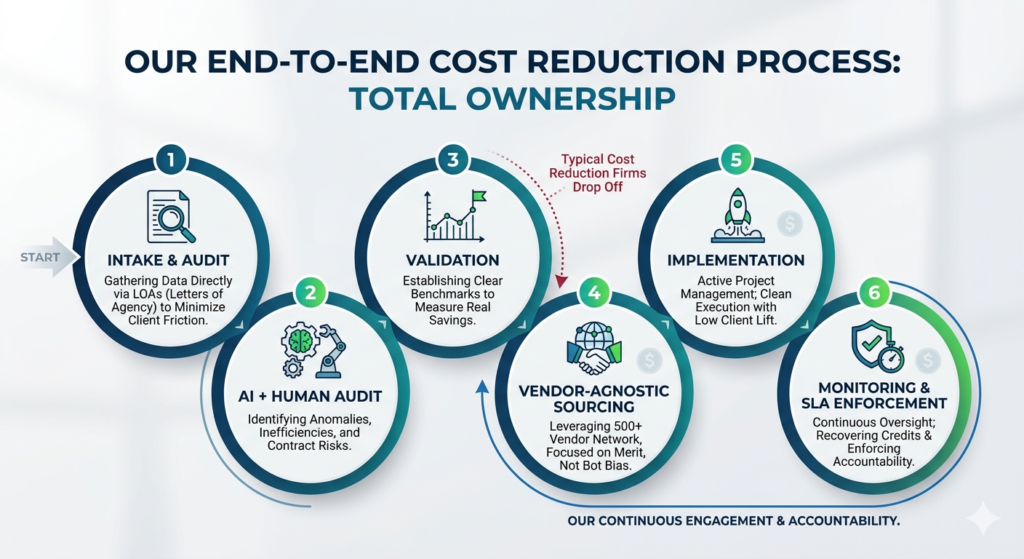
We built our model around one principle. If we are responsible for the outcome, we should own the process end to end.
Intake and Audit (Including LOAs)
We start by removing friction. Through LOAs, we gather vendor data directly so your team does not have to chase it.
LOA’s reduction friction through our process and prevent costly bottlenecks.
AI + Human Audit Layer

We combine human review with AI to identify anomalies, inefficiencies, and contract risks.
Validation
We establish a clear benchmark of your current costs. This becomes the foundation for measuring savings.
Vendor-Agnostic Sourcing
We work across a network of 500+ vendors. That network evolves constantly because markets change.
We do not rely on “who was good last year,” although that is relevant.
Implementation
We act as a project manager on top of the vendor’s team to ensure execution is clean and low lift for you.
Monitoring and SLA Enforcement
This is where most firms disappear. We stay involved to ensure vendors meet their obligations.
If they don’t, we enforce it.
Compensation Models Explained (And Where Bias Comes From)
Compensation structure drives behavior.
Some firms require upfront fees. Others take a percentage of savings. Some are paid by vendors.
Each model introduces different incentives.
We operate on a performance-based structure:
- Small upfront engagement fee (applied toward savings)
- 40/60 split on realized savings over a minimum term (if curious, just ask us)
We are also transparent about vendor commissions. In many cases, we pass those through to increase client savings.
The goal is alignment, not extraction.
Where Savings Actually Come From
Savings typically fall into three categories:
1. Keep and Renegotiate
Lowest disruption, lowest savings.
2. Right-Sizing
Moderate change, stronger savings.
3. Rebuilding from the Ground Up
Highest impact, requires operational change.
The biggest savings come from organizations willing to rethink how things are structured.
Case Study: When We Were Called Too Late
We worked with a manufacturer that had already signed into a long-term equipment lease.
We identified a path to save close to six figures if the lease ran its course and was restructured properly.
Instead, they opted to renew before lease end which, while not recommended, can still yield savings.
That pushed the opportunity further out and increased their cost burden.
Not every story is a win. Timing matters.
Case Study: Preventing the Wrong Decision
The cheapest option is rarely the best option. The cheapest vendors don’t often make our short list.
The reasons are we focus heavily on:
- SLA structure
- Exit clauses
- Vendor accountability
In one case, we guided a client away from a lower-cost provider because the contract lacked enforceable protections.
That decision avoided long-term risk that would have outweighed any short-term savings.
Why Companies Don’t Capture These Savings Themselves
It comes down to two things.
Time and expertise.
Procurement requires:
- Market awareness
- Vendor leverage
- Contract fluency
- Negotiation discipline
Most internal teams are already at capacity and do they care as much as you do?!
On top of that, there is procurement fatigue. People simply do not want to go through another cycle unless they have to.
Add in vendor relationships and sales pressure, and the path of least resistance becomes staying put.
What Happens After the Savings
This is where the real differentiation shows up.
We operate in a thankless industry. Clients are not calling to celebrate savings every day.
But they do:
- Come back to us for additional categories (over 85% do)
- Rely on us when issues arise
- Trust us to hold vendors accountable
We had a recent situation where a client experienced repeated downtime.
The vendor failed to issue credits tied to SLA violations.
We tracked the data, enforced the contract, and recovered the credits.
That is part of the engagement.
Savings are the entry point. Accountability is what keeps clients.
DEBottom Line: Come for the Savings, Stay for the Experience
There is no shortage of firms that can identify savings. There are fewer looking to break up the status quo!
The difference is what happens after that.
We focus on removing effort, reducing risk, and owning the process from start to finish.
That is why clients come to us for savings and ultimately, why they stay.