
Telecom Expense Management Consulting
Telecom Expense Management That Reduces Spend and Improves Contract Position
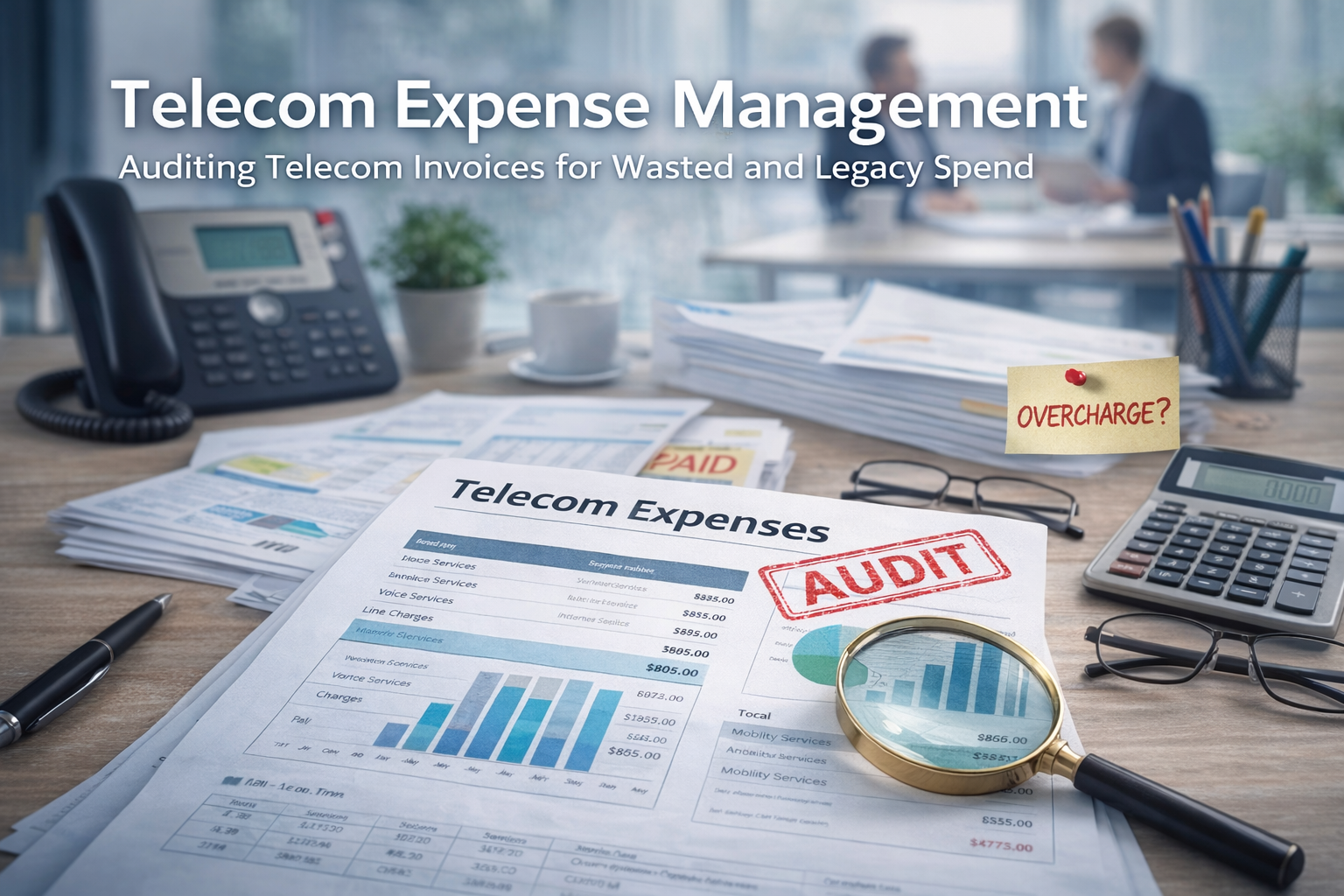
We help organizations review circuits, voice services, internet connectivity, carrier agreements, legacy telecom, and network-related contracts to uncover hidden savings, eliminate waste, and improve renewal outcomes without adding more work to internal teams.
What we review
- Internet, DIA, broadband, and ethernet costs
- Voice and UCaaS agreements
- Carrier contracts and renewals
- Legacy lines and POTS replacement opportunities
- Circuit inventory and service alignment
- SD-WAN, network design, and connectivity strategy
What Is Telecom Expense Management?
Telecom expense management is the process of reviewing, validating, optimizing, and managing the costs associated with an organization’s voice, data, connectivity, and network services. That includes carrier invoices, internet circuits, voice platforms, wireless or legacy services, contract terms, renewal language, and the broader structure of how telecom is purchased and maintained.
For many companies, telecom costs build over time without a deliberate review process. Locations are added. Circuits stay in place. Pricing ages. Contracts renew. Migrations happen unevenly. Different sites end up with different structures, different vendors, and different rates. The result is often higher spend and less flexibility than the business actually needs.
Telecom expense management consulting helps bring visibility and discipline back to those decisions so costs better reflect current usage, current market conditions, and current operational needs.
Why Companies Commonly Overpay for Telecom
Telecom is one of the easiest categories for spend to drift because it sits at the intersection of operations, IT, procurement, and vendor management. It is critical to the business, but often reviewed only when something breaks or a renewal surfaces.
Contracts Quietly Renew
Carrier agreements often contain auto-renewal language, evergreen terms, escalators, or renewal structures that reduce leverage over time.
Inventory Does Not Match Reality
It is common to find circuits, services, voice paths, or legacy lines that are oversized, duplicated, outdated, or no longer necessary.
Internal Teams Lack Time
Reviewing every bill, validating every service, comparing every carrier, and renegotiating every agreement is detailed work that most teams simply do not have time to pursue consistently.
What We Help Clients Evaluate
Our telecom expense management process examines every major component of your communications environment to identify cost-saving opportunities, reduce vendor risk, and ensure your technology supports your business objectives.
Carrier Contracts
Analyze pricing, contract terms, renewal provisions, escalators, installation charges, and service commitments to uncover hidden costs and improve negotiating leverage.
Internet & Connectivity
Review DIA, broadband, Ethernet, fiber, and backup connectivity to ensure each location has the right services, capacity, and redundancy without unnecessary expense.
Voice & UCaaS Platforms
Evaluate hosted voice solutions, Microsoft Teams, SIP, seat counts, licensing, and feature utilization to optimize both performance and long-term costs.
POTS & Legacy Services
Identify legacy phone lines and outdated telecom services that continue generating recurring charges and develop practical modernization strategies.
Network Architecture
Assess SD-WAN, MPLS, bandwidth allocation, circuit redundancy, and overall network design to ensure your infrastructure supports current operational needs.
Renewal Strategy
Leverage benchmarking, competitive sourcing, and contract timing to negotiate stronger agreements before renewal deadlines reduce your options.
Telecom Expense Management Is Part of a Bigger Cost Strategy
Telecom is often one of the first categories we review, but it is rarely the only one. It usually connects to broader technology, vendor, and procurement decisions that influence overall spend.
Technology Expense Management
See how telecom fits into broader technology expense optimization across SaaS, cloud, print, and vendor agreements.
Vendor Contract Negotiation
Explore how better contract structure and negotiation strategy improve savings beyond the initial rate review.
Technology Expense Audit
Learn how a structured audit helps uncover hidden telecom and technology savings before contracts renew again.
How Our Telecom Expense Management Process Works
We built our process to be deliberate, predictable, and practical. Clients are usually not looking for another project to manage. They are looking for someone to help bring order to a category that easily gets overlooked.
Gather and Review
We collect current invoices, contracts, service inventories, renewal details, site information, and operational requirements.
Validate and Benchmark
We identify outdated pricing, unused or mismatched services, contract weaknesses, and areas where the market may support better options.
Negotiate or Source
Depending on the scenario, we negotiate with incumbents, source alternatives, or restructure the approach to improve cost and flexibility.
Support Implementation
We help carry the process through vendor coordination, contracting, transition planning, and renewal awareness so savings stick.
What Better Telecom Expense Management Improves
A lower monthly rate is only part of the value. Good telecom expense management improves visibility, contract position, network design decisions, and the amount of effort required from already stretched teams.
- Reduced recurring telecom and connectivity spend
- Cleaner visibility into services by site and by vendor
- Improved carrier contract terms and renewal leverage
- Better alignment between network design and business need
- Less waste tied to outdated circuits or legacy services
- Lower internal lift for finance, IT, and operations teams
Telecom costs are rarely just a rate problem
In many environments, the larger issue is structure. Services were added over time, contracts were signed under different conditions, and nobody has had the time to step back and evaluate the whole picture. That is where meaningful savings usually appear.
Talk with us about your telecom environmentTelecom Cost Reduction Should Still Protect Performance and Resilience
Not every telecom decision should be driven by the lowest possible price. Connectivity supports uptime, customer experience, application performance, and site continuity. In some environments, redundancy, service quality, and implementation support matter more than headline savings.
Our role is not to force a race to the bottom. It is to help organizations make better-informed telecom decisions by balancing cost, performance, resilience, and contract quality. In some cases, the right answer is a less expensive structure. In others, the right answer is a stronger network design with smarter spend behind it.
Who This Is Built For
Print cost reduction is especially useful for organizations with multiple sites, decentralized device decisions, aging copier agreements, or environments where fleets have evolved without a deliberate review.
Healthcare
Organizations managing device-heavy environments, multiple departments, and service expectations tied to day-to-day care delivery.
Manufacturing
Businesses with administrative, operational, and facility-based print needs spread across locations.
Nonprofits
Lean organizations looking to reduce fleet and service costs without adding complexity to already limited teams.
Multi-Location Businesses
Organizations with inconsistent fleets, multiple vendors, and decentralized print decisions that have become hard to manage centrally.
Frequently Asked Questions About Telecom Expense Management
What does telecom expense management include?
It includes the review and management of carrier invoices, internet and data services, voice platforms, circuits, contract terms, renewal structures, legacy telecom, and related vendor agreements.
Can telecom expense management help before a contract renews?
Yes. In fact, that is often the best time to act. Once a renewal is accepted or leverage is lost, options can narrow quickly. Early review typically creates better negotiation outcomes.
Is this only for large enterprises?
No. Mid-market companies, nonprofits, healthcare groups, manufacturers, and multi-location organizations often benefit substantially because telecom complexity tends to build faster than internal review capacity.
How do you get paid?
Our model is performance-based. If we do not find savings, you do not pay. That keeps our incentives aligned with client outcomes.
Ready to Take a Closer Look at Your Telecom Spend?
We can review your contracts, invoices, circuit inventory, and renewal timing to help uncover savings, improve carrier terms, and build a stronger approach going forward.