What Questions to Ask a Cost Reduction Consultant Before You Hire One
Questions to ask a cost reduction consultant should go far beyond “how much can you save us?” The right questions help you understand incentives, process, implementation, and whether the consultant is actually built to deliver results.
TL;DR
Not all consultants operate the same, so asking the right questions to ask a cost reduction consultant is what determines whether you save money or waste time.
- Talk to multiple providers, not just big names or franchises.
- Understand how they work, not just what they promise.
- Performance-based models should align incentives.
- Avoid consultants who only provide recommendations without implementation.
- If they rush, guarantee savings without data, or hide their process, walk away.
Questions to ask a cost reduction consultant should help you understand much more than potential savings. You need to know how they work, how they are paid, how much lift your team will have, and whether they actually implement savings or just hand you recommendations.
Most firms sound similar on the surface. They talk about savings, benchmarking, vendor negotiations, and procurement expertise. The difference shows up once you ask better questions.
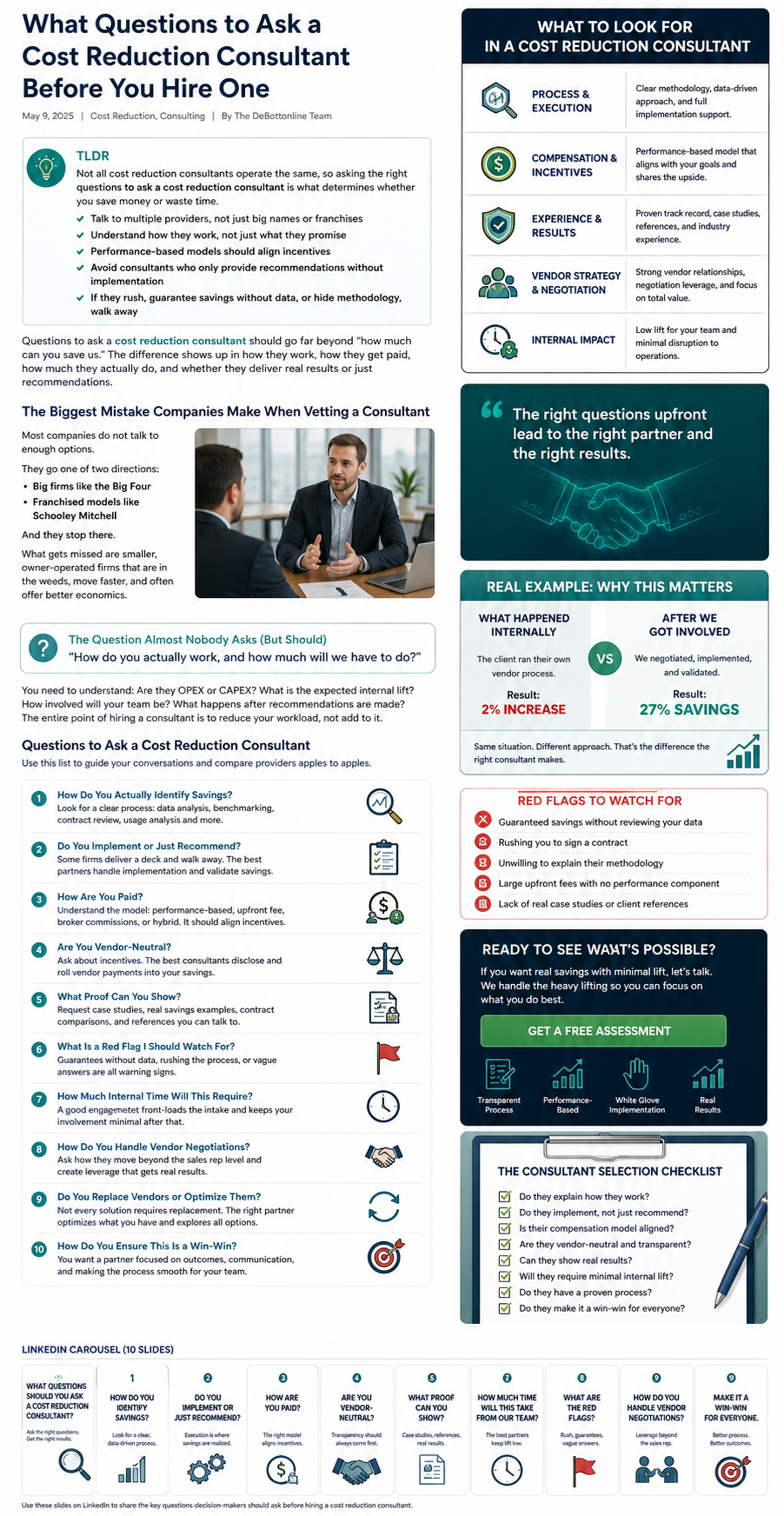
Use this checklist to compare cost reduction consultants before choosing a partner.
The Biggest Mistake Companies Make When Vetting a Consultant
The biggest mistake is not talking to enough options.
Many companies look at one of two paths:
- Large firms like Deloitte or the Big Four
- Franchise-style consulting models
Those may be valid options, but they are not the only options.
Smaller, owner-operated firms can often be closer to the work, more flexible, and more accountable because the person selling the engagement is also involved in delivering the result.
If you are not comparing a few different models, you are not really evaluating the market.
The Question Almost Nobody Asks, But Should
“How do you actually work, and how much will we have to do?”
This is one of the most important questions to ask a cost reduction consultant because the entire point is to remove burden from your team.
You should understand:
- Are they OPEX or CAPEX?
- How are they compensated?
- How much internal lift is required?
- Do they implement or just recommend?
- What does communication look like during the process?
If hiring a consultant still leaves you managing vendors, reviewing every quote, and chasing every update, the model is not doing enough for you.
10 Questions to Ask a Cost Reduction Consultant
1. How do you actually identify savings?
You want a real process, not a vague promise. Ask about invoices, contracts, usage, benchmarking, vendor outreach, and savings validation.
2. Do you implement or just recommend?
Some firms deliver a deck and leave implementation to your team. That creates more work. The better question is whether they stay involved until savings are live.
3. How are you paid?
Compensation can be performance-based, upfront, commission-based, or a mix. Make sure their incentives align with your savings.
4. Are you vendor-neutral?
If vendor commissions exist, ask how they are handled. Transparent consultants disclose incentives and roll them into the savings model when appropriate.
5. What proof can you show?
Ask for case studies, savings examples, references, contract comparisons, and real stories from clients who have been through the process.
6. What are the red flags?
Ask them what should concern you. Guaranteed savings without data, rushed timelines, and vague methodology are all warning signs.
7. How much time will this require from our team?
A good process is heavier upfront during intake, then lower lift once the consultant has what they need.
8. How do you handle vendor negotiations?
There is a difference between dealing with sales reps and dealing higher in the organization where pricing and revenue decisions are made.
9. Do you replace vendors or optimize them?
Not every solution requires a vendor change. Sometimes the best answer is fixing the current agreement.
10. How do we make this a win-win?
This question reveals whether they understand your priorities, communication style, risk tolerance, and definition of success.
How to Evaluate Compensation Models
One of the most important questions to ask a cost reduction consultant is how they get paid.
Performance-based compensation can work well because it aligns incentives. If savings are created, the consultant shares in those savings. If meaningful savings are not there, the engagement should not move forward.
But performance-based can mean different things:
- Some consultants split savings 50/50.
- Some take more than 50%.
- Some take less.
- Some require large upfront CAPEX-style payments.
- Some earn broker commissions from vendors.
The model needs to work for your company. A large upfront fee tied to several years of future savings may not make sense if it creates a cash flow problem. A cleaner OPEX structure may be easier to adopt and easier to justify.
For more context on realistic savings, review our guide to cost reduction consulting savings.
Why Implementation Matters More Than Recommendations
Recommendations are useful, but recommendations alone do not create savings.
The bigger the firm, the more likely you may be to receive a polished deck with findings and next steps. That can be valuable, but if your team has to implement everything afterward, you have not removed the burden.
The better model includes:
- Thorough intake
- Vendor coordination
- Benchmarking
- Negotiation
- Implementation support
- Savings validation
The goal is low internal lift, real savings, and a process that allows your team to keep focusing on its actual priorities.
What to Ask About Vendor Bias
Bias isn’t always obvious, but it plays a larger role in decision-making than most companies realize. Research from Harvard Business Review highlights how hidden biases can influence major business decisions, which is why transparency in vendor relationships and incentives matters.
Bias exists in almost every advisory model. The question is not whether it exists, but how it is handled.
If a vendor pays a commission, you should be asking:
- Is that commission disclosed?
- Is it rolled into the savings calculation?
- Does the client share in that benefit?
- Are vendors being compared fairly?
At DE Bottom Line, when vendor-paid incentives are part of the equation, they are rolled into the savings structure. That matters because hidden vendor incentives can distort recommendations.
For a deeper look at this topic, read our article on why bias matters in consulting.
What Proof Should You Ask For?
There is no such thing as a bad referral. If a consultant has delivered, they should be able to show it.
Ask for:
- Relevant case studies
- Validated savings examples
- Client references
- Contract comparison examples
- Industry-specific experience
You should also ask what the process looked like from the client side. Savings matter, but so does the experience of getting there.
Red Flags to Watch For
Some warning signs are obvious. Others are subtle.
- They guarantee savings before reviewing data.
- They rush you into signing.
- They will not explain their methodology.
- They only talk about recommendations, not execution.
- They are vague about compensation.
- They cannot show real examples.
It is fine for a consultant to be confident. It is not fine for them to make big promises before understanding your contracts, usage, vendors, and current pricing.
A Real Example: Why the Right Consultant Matters
A nonprofit came to us after going through a vendor process internally. They had already received a proposal and asked whether it was too late for us to get involved.
Before we got involved: the proposal included a 2% increase.
After we got involved: the final result was 27% savings off that proposal.
Same environment. Different process.
That is why these questions matter. A consultant should not just get involved to validate what already happened. They should bring a better process, better leverage, and better visibility.
Do They Replace Vendors or Improve Existing Agreements?
Some consultants treat replacement as the default answer. That can create disruption when disruption is not needed.
In many cases, the better move is to keep the current vendor but improve the agreement, pricing, terms, or scope.
That is why one of the best questions to ask a cost reduction consultant is whether they are trying to replace vendors or optimize outcomes.
For more on that strategy, read how to stay with your vendor and still reduce cost.
How Much Internal Lift Should You Expect?
A strong engagement should be front-loaded.
That means the consultant should ask for a thorough intake at the beginning so your team is not constantly pulled into the process later.
Expect to provide:
- Current invoices
- Contracts
- Usage information
- Vendor contacts
- Business requirements
- Stakeholder priorities
After that, your involvement should decrease. Communication still matters, especially because projects can run 30 to 60 days or, in some cases, six to eight months. If something changes internally, your consultant needs to know.
The One Question That Separates Good From Great
“How do we make sure this is a win-win for everyone involved?”
This question forces the consultant to explain how they will align their process with your business priorities.
The answer should cover:
- What they need from you
- How they communicate
- How they manage vendors
- How they avoid disruption
- How they validate savings
- How they define success
A great consultant is not just chasing savings. They are making sure the engagement works inside your organization.
Want to Know if We Are the Right Fit?
If you are evaluating cost reduction consultants, we are happy to walk through how our process works, where we may be able to help, and whether the opportunity is worth pursuing.
Request an AssessmentDEBottom Line
Asking the right questions to ask a cost reduction consultant can save you from the wrong engagement.
You are not just hiring someone to find savings. You are hiring a process, a compensation model, a level of execution, and a partner that should reduce the burden on your team.
If they cannot clearly explain how they work, how they are paid, how much lift they require, and how they validate results, keep looking.
The right consultant should make the process easier, not harder.