How to Reduce Medical Translation Costs Without Disrupting Patient Care
Medical translation services are essential, but that does not mean they should be inefficient. Many healthcare organizations are overpaying because of inconsistent pricing, billed hold time, weak contract structure, and limited visibility into how language services are actually being used.
TL;DR
Most opportunities for medical translation cost reduction are not about cutting access. They come from fixing structure. Healthcare organizations often pay too much because of fragmented pricing, billed hold time, poor reconciliation, and a lack of visibility into which languages drive the majority of volume.
- Translation spend is often concentrated in a very small number of languages.
- Billed hold time and long waits can create major billing leakage.
- Standardized pricing and better controls can materially reduce cost.
- The goal is to reduce medical translation costs without hurting care delivery.
For the real-world proof behind this article, review our medical translation cost reduction case study.
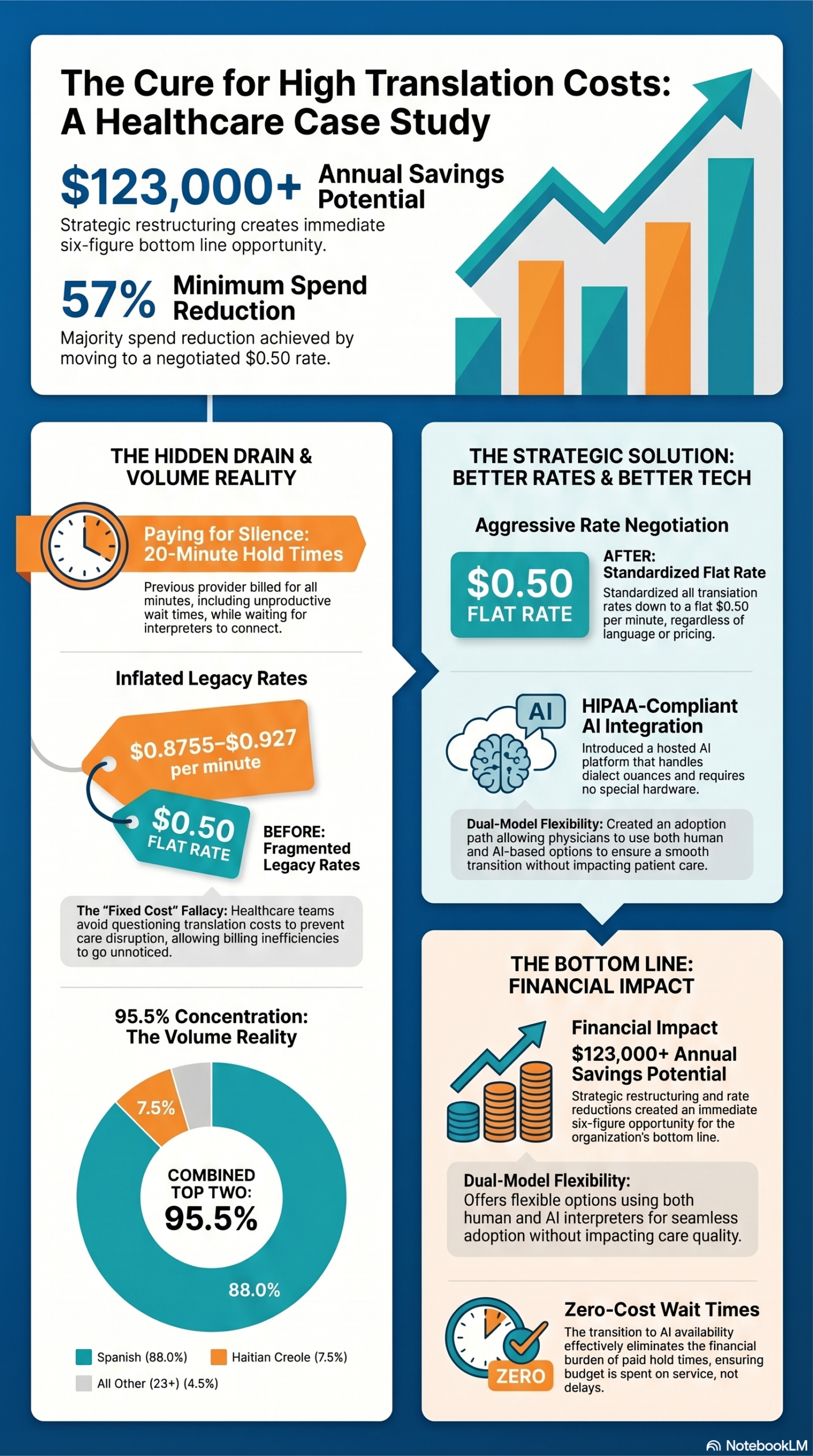
Why Medical Translation Costs Are Higher Than They Should Be
Healthcare organizations rarely question language services until the invoices become impossible to ignore. That is understandable. Translation services feel operational, necessary, and sensitive. Because they support patient communication, they often get treated as a category that should not be challenged.
That mindset is exactly why unnecessary spend builds up.
In practice, the biggest opportunities to reduce medical translation costs usually come from the same places we see in other vendor categories: weak contract terms, billing leakage, limited benchmarking, and very little validation of what is actually being paid for. The difference is that language services often avoid scrutiny because teams do not want to risk disruption.
But reducing medical translation costs does not mean cutting corners. It means improving pricing structure, tightening billing controls, and matching the service model to actual usage.
While translation is its own category, the same patterns show up across vendor spend, and understanding broader cost reduction consulting savings can help put these opportunities into perspective.

What Usually Drives Excess Spend in Medical Translation Services
Organizations trying to achieve meaningful medical translation cost reduction should start by reviewing the category structurally, not emotionally. The biggest cost issues are usually hidden in plain sight.
1. Language concentration is ignored
Many organizations assume translation volume is widely distributed. In reality, most usage is often concentrated in one or two languages. That concentration should drive pricing strategy, vendor structure, and negotiation leverage.
2. Hold time gets billed like service time
One of the easiest ways to overpay is by paying for minutes that are not productive. If your team is waiting for an interpreter, transferred between queues, or sitting on hold, that is not the same as delivering value.
3. Pricing tiers drift over time
Different rates by language, channel, or usage type can create unnecessary complexity. Without strong oversight, that complexity turns into margin for the provider and waste for the client.
Other common issues include:
- Inconsistent quality across interpreters or channels
- Long connection times that slow down staff and patient flow
- No practical reconciliation process for invoices
- Contracts that were never benchmarked against the market
- Language service spend reviewed separately from broader vendor optimization
That last point matters. Translation services may sit outside traditional telecom or SaaS discussions, but they still belong inside a broader technology expense audit and vendor expense review process.
A Real Pattern We See Again and Again
In one healthcare engagement, the overwhelming majority of usage was concentrated in just two languages. That alone changed the conversation. Instead of treating every language the same and accepting fragmented pricing, the spend could be evaluated strategically.
The more important issue was not just the rate. It was the billing logic. Time spent waiting could still be billable. That means organizations were not simply paying for interpretation. They were also paying for inefficiency.
Review the full example in our medical translation cost reduction case study if you want to see how the structure, pricing, and delivery issues came together in one engagement.
How to Reduce Medical Translation Costs Without Creating New Problems
If your goal is to reduce medical translation costs, start with discipline, not disruption. The right process improves cost structure while protecting access, quality, and compliance.
1. Review usage before reviewing vendors
Before exploring alternatives, understand where minutes are actually going. Which languages dominate usage? Which departments rely on the service most? Are wait times creating non-productive spend? This is where many savings opportunities first become visible.
2. Separate service value from billing leakage
Minutes used for active interpretation are one thing. Minutes billed because a staff member was waiting are something else entirely. If you do not separate those two categories, you cannot accurately evaluate what you are paying for.
3. Standardize pricing wherever practical
Organizations often accept pricing complexity that no longer serves them. Standardized rate structures can make invoices easier to validate and reduce unnecessary spread between languages or channels.
4. Evaluate the service model, not just the rate card
A lower price per minute is not automatically a better answer if access is poor or quality is inconsistent. The real objective is better total value: cost, access, reliability, compliance, and user experience.
5. Treat translation spend like every other vendor category
This is still a vendor expense. It should be benchmarked, validated, and managed with the same discipline used for vendor contract negotiation, technology expense management, and broader cost reduction services.
What Not to Do When Reviewing Language Service Costs
A lot of organizations know they are overpaying, but still approach the issue in a way that creates risk or misses the real opportunity.
Do not focus only on rate per minute
If wait time, billing practices, or poor service delivery remain unchanged, a lower rate alone may not solve the problem.
Do not assume all usage is equally strategic
Volume concentration matters. Your dominant languages should influence the commercial structure.
Do not treat this as too sensitive to review
You can reduce medical translation costs responsibly. The right review improves control without reducing access.
This is similar to what happens in other overlooked categories. Organizations often stay with the status quo because reviewing alternatives feels like too much effort. That same pattern shows up in telecom, cloud, SaaS, print, and language services alike.
If that sounds familiar, this article on how to stay with your vendor and still reduce cost is worth reading next.
The Bigger Takeaway
Medical translation costs are often treated like a fixed reality. They are not. In many cases, the spend is simply unmanaged.
The biggest wins tend to come from:
- understanding actual language usage patterns
- eliminating billed non-productive time
- tightening invoice validation
- simplifying pricing structure
- aligning service delivery with operational needs
That is why medical translation cost reduction should not be viewed as a one-off negotiation. It is part of a larger effort to create visibility and control across vendor spend.
Related Pages and Articles
If this is a category you are reviewing now, these pages are the best next clicks:
- Medical Translation Cost Reduction Case Study for the full proof story
- Technology Expense Management for the broader governance approach
- Technology Expense Audit to see what hidden spend categories often surface
- Cost Reduction Services for how DE Bottom Line approaches these engagements
- Vendor Contract Negotiation for contract and pricing leverage strategy
- How to Stay With Your Vendor and Still Reduce Cost if you want savings without unnecessary churn
Think You May Be Overpaying for Medical Translation Services?
If your organization is dealing with inconsistent pricing, billed hold time, or limited visibility into translation usage, there may be a clear path to savings without disrupting care delivery. The first step is understanding where the waste actually sits.