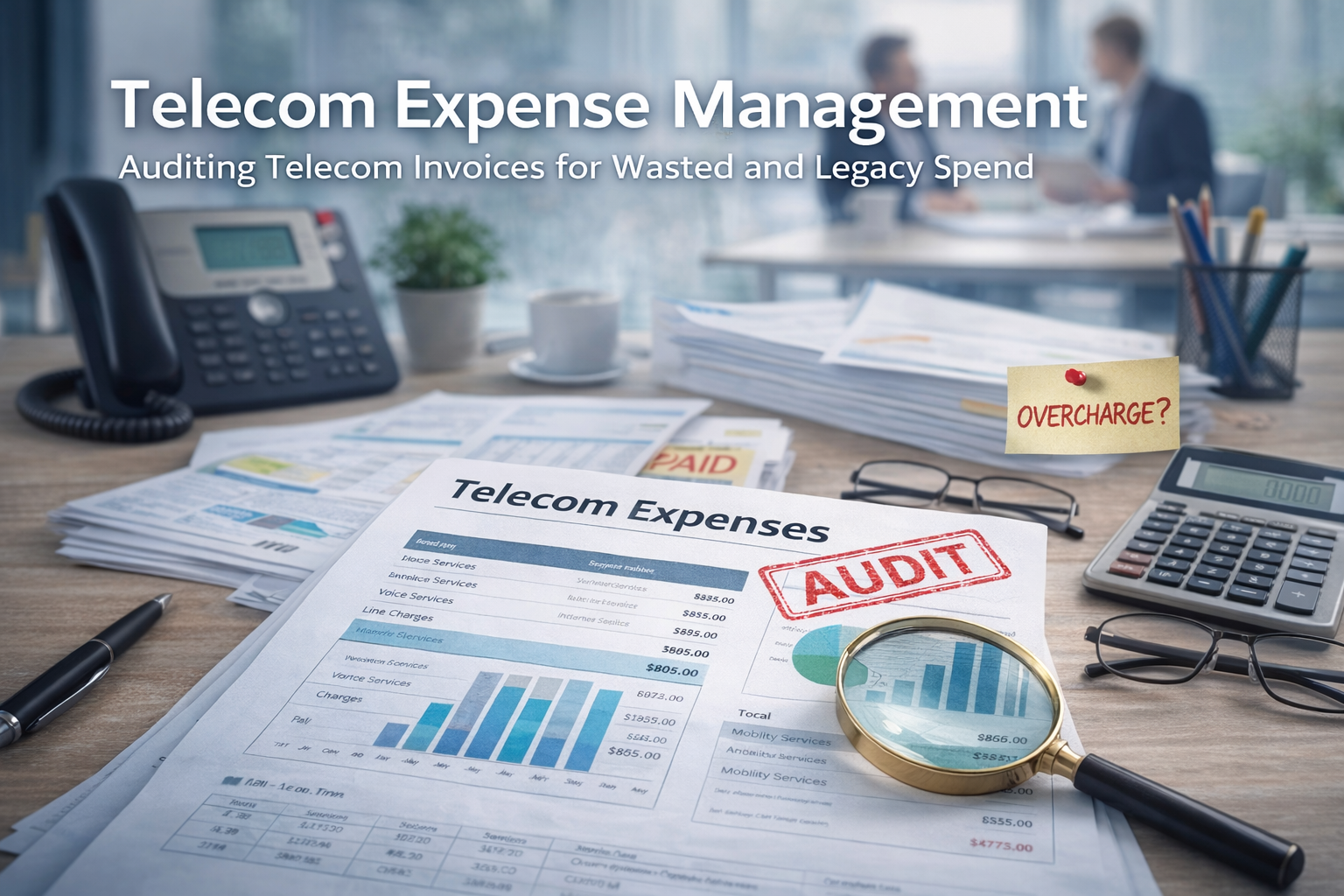
Telecom Expense Management is not just about negotiating rates. It is about finding spend that no longer matches reality, fixing governance gaps, and making sure legacy telecom costs do not continue unchecked.
Telecom Expense Management: How Legacy Spend Slips Through the Cracks
Most organizations think telecom waste would be obvious.
Sometimes it's not.
Telecom Expense Management matters because billing often survives long after the environment has changed. Services are migrated, platforms are replaced, locations evolve, and old costs keep showing up month after month because no one has time to reconcile the full picture.
That is exactly where a disciplined telecom review can create real value. Not by inventing problems. By validating what still belongs and what does not.
TL;DR
Telecom Expense Management helps organizations align telecom spend to actual usage, current systems, and real business needs. In one recent engagement, a nonprofit healthcare organization expected to find some savings. What surfaced instead was nearly a full elimination of a legacy telecom spend category because the organization had already moved to a different UCaaS environment. The issue was not the vendor. It was lack of governance, fragmented oversight, and billing that was never fully reconciled.
Why Telecom Expense Management Still Matters
Telecom has a habit of drifting.
It happens in organizations of every size, but especially in multi-location environments where finance, IT, operations, and vendors all touch the account in different ways. Over time, systems overlap, invoices become routine, and services that should have been disconnected continue billing in the background.
That is why Technology Expense Management often starts with telecom. It is one of the fastest places to uncover waste, identify governance gaps, and build a clearer view of the broader vendor environment.
What Telecom Expense Management Actually Looks For
A proper telecom review is not just a pricing exercise. It looks at:
- Services that are still billing but no longer needed
- Legacy voice or line-based environments that were never fully removed
- Overlapping solutions after migrations or platform changes
- Billing structures that do not match current usage
- Contract terms that keep outdated costs alive
That is part of what makes a cost reduction process effective. You are not guessing where waste may exist. You are validating it against actual invoices, actual services, and actual operational needs.
1. The Biggest Telecom Problems Usually Start as Governance Problems
In this case, the client was a nonprofit healthcare organization, specifically a Federally Qualified Health Center, with roughly 350 employees across 20 locations and under $50 million in revenue.
They expected there could be some savings.
What they did not expect was nearly a complete overhaul of part of their telecom bill.
The organization had already implemented a different UCaaS solution. The problem was that parts of the prior telecom environment were still billing in parallel. That was not because the vendor was doing something improper. The billing was continuing as it had been set up to do. The issue was that no one had fully stepped back to reconcile the old environment against the new one.
2. Legacy Spend Does Not Always Look Like Waste at First
This is where organizations get caught.
A telecom invoice may look normal simply because it has looked normal for a long time. Charges become familiar. Approvals become routine. Teams assume someone else already reviewed it. The result is that old spend can stay in place well beyond its useful life.
In this engagement, that legacy spend was not a small adjustment. It was significant enough that, once reviewed and corrected, the savings were nearly 100 percent for that portion of the bill.
That comes with an asterisk, of course. This was not a typical rate negotiation story. It was a cleanup story. But that is exactly why it matters. It proves how expensive poor governance can become when nobody checks whether the billing still reflects reality.
3. The Goal Was Not Just Lower Pricing
One of the biggest misconceptions around Telecom Expense Management is that it is only about getting a better deal from the carrier.
In many cases, though, the bigger win comes from identifying services that should not still exist. That is what happened here. The engagement was less about pressuring a vendor for better rates and more about aligning billed services to the actual environment.
Some of that spend was then moved appropriately into other solutions, including eFax. Other pieces, such as POTS replacements for elevator and fire lines, remained part of the ongoing review because those services still require a careful transition plan.
4. Good Telecom Reviews Usually Open the Door to More
Once a client sees that this kind of waste exists in telecom, the next question comes quickly:
Where else is this happening?
That was the natural next step here. After the telecom review, the client expanded the conversation into internet and network infrastructure.
That is consistent with how many of our engagements grow. Telecom becomes the first proof point. From there, clients begin looking at cloud, SaaS, connectivity, contracts, and broader vendor governance with a different lens.
If someone is still learning how these engagements are structured, this also pairs naturally with how cost reduction engagements are structured.
5. Telecom Expense Management Fits the DEBottom Line Narrative Perfectly
This is a clean example of what DE Bottom Line is really solving.
Not just high rates.
Not just bad vendors.
The bigger issue is often lack of time, lack of ownership, and lack of governance around spend categories that quietly drift over time.
That is why cost reduction services work best when they go beyond surface-level benchmarking. Real value comes from reviewing invoices, validating need, checking contracts, and helping clients act on what is found.
Telecom is often one of the largest opportunities, but it’s just one piece of a much larger picture when you look at overall cost reduction consulting savings.
In this case, the client told us they found more savings than they expected. That is a strong result, but it is also a revealing one. It means the opportunity was already there. It just had not been surfaced yet.
DEBottom Line
Telecom Expense Management is one of the clearest examples of why governance matters.
Legacy spend rarely announces itself. It usually hides inside familiar invoices, old assumptions, and environments that changed faster than the billing ever did.
That is why a proper telecom audit can do more than improve pricing. It can eliminate spend that no longer belongs, sharpen visibility, and lead directly into broader infrastructure and vendor decisions.
If your organization has changed platforms, added locations, or simply has not reviewed telecom in a while, there is a good chance the bill deserves a second look.
Related Reading
Wondering Whether Legacy Telecom Spend Is Still Hiding in Plain Sight?
If your team has changed systems, migrated platforms, or inherited invoices that no one has reviewed closely, there may be more opportunity than you think.