What Efficiency Really Means in Business
TL;DR
Efficiency in business is not about paying less or moving faster. It is about aligning cost, time, and outcomes. The biggest inefficiencies usually hide in recurring expenses, unmanaged vendors, auto renewals, and internal time drain. True efficiency creates control, flexibility, and focus without disrupting operations.
Why Efficiency Is So Often Misunderstood
Ask ten leaders what efficiency means and you will get ten different answers.
Some will say lower costs.
Others will say higher productivity.
Some will point to fewer vendors or faster execution.
None of those are wrong. They are just incomplete.
In practice, efficiency breaks down not because organizations do not care about it, but because they define it too narrowly. Most teams focus on visible line items and obvious processes. The real problems tend to live quietly in the background, billing every month and demanding attention only when something breaks.
Efficiency is less about doing things cheaper and more about doing the right things with intention.
Where Leaders Think They Are Efficient (But Usually Aren’t)
In almost every audit we run, the same areas come up.
Telecom
SaaS subscriptions
Print environments
Recurring vendor contracts
These are assumed to be under control because they feel small, routine, or already decided.
Telecom bills get paid because phones work.
SaaS renews because teams might need licenses later.
Print feels like a penny business, not worth deep scrutiny.
As organizations run leaner, governance quietly takes a back seat. No one is doing anything wrong. There just is not a clear owner watching these categories month to month.
The result is slow, compounding inefficiency. Small charges stack. Old services linger. Terms lock in. And by the time someone notices, the spend feels permanent.
The Most Common “Efficient” Decision That Creates Long-Term Problems
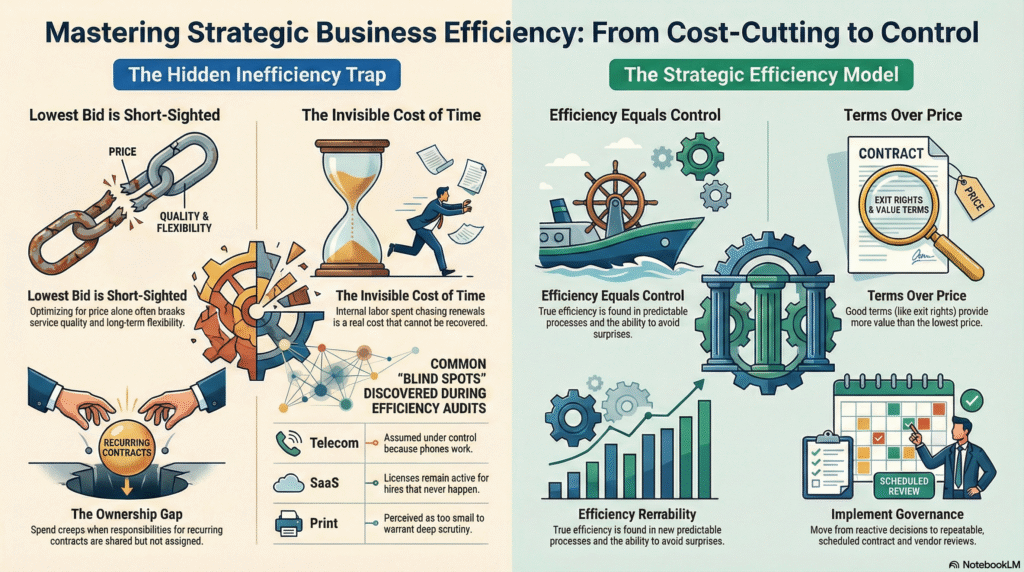
On paper, lowest bid wins looks efficient.
In reality, it is often short sighted.
Price alone ignores the things that actually determine whether a deal holds up over time. Terms. Service. Flexibility. Support. The quality of the partner on the other side.
We tell clients this upfront. There is always a cheaper option. ALWAYS! The goal is not to find the lowest number. The goal is to find the right balance of price, value, terms, service, and partner fit.
If you optimize for only one of those, something else will eventually break. Usually service. Sometimes flexibility. Often both.
That is when a “cheap” decision gets expensive.
Efficiency Without Cutting Spend
One of the biggest misconceptions about efficiency is that it must involve cutting dollars.
Harvard Business Review has noted that efficiency efforts often fail when focused only on cost
Some of the most meaningful efficiency gains come from removing friction instead.
Fewer vendor meetings
Fewer emails
Fewer renewals to chase
Fewer decisions that pull leaders away from their real work
When organizations offload vendor coordination, negotiation, and follow-up, they are not just saving money. They are buying back time.
Time is the scarcest resource inside any organization. When teams are no longer buried in vendor management, they can focus on what actually moves the business forward.
That is efficiency.
The Inefficiencies That Persist Because No One Owns Them
Certain problems survive simply because responsibility is assumed, not assigned.
Legacy telecom services that are “in the process” of being decommissioned
Licenses purchased for future hires that never happen
Auto renewals that quietly lock in bad terms
Contracts no one has revisited in years
None of this happens out of neglect. It happens because these items live between departments. Finance pays the bill. IT supports the service. Operations uses it. No one owns the ongoing review.
Efficiency requires ownership. Without it, spend creeps and control erodes.
Why Time Is More Expensive Than Overpaying Vendors
You can overpay a vendor and recover.
You cannot recover lost time.
Internal labor spent chasing invoices, coordinating vendors, and managing renewals rarely shows up as a line item. But it is real cost. And it grows as environments get more complex.
This is why terms matter so much. Good terms create flexibility. Flexibility creates efficiency.
If forced to choose between good price and good terms, good terms win every time. Exit rights, month to month options, and clear renewal windows protect the organization from being trapped later.
Lock in feels safe until it is not.
When Efficiency Feels Disruptive (But Isn’t)
Resistance to change shows up constantly.
A common scenario looks like this. A long-time vendor offers to reduce pricing by 20 percent to keep the business. A competing option could save 40 percent. Many organizations choose the smaller savings to avoid perceived transition risk.
This happens even when transitions are phased, supported, and designed to minimize disruption.
The status quo feels efficient because it is familiar. That does not mean it is optimal.
Efficiency is not about constant change. It is about knowing when change is worth it and how to manage it without chaos.
Lean Teams and Large Enterprises Struggle the Same Way
There is a belief that inefficiency is a big company problem.
It is not.
Lean teams miss things because life happens. Priorities shift. Reviews get postponed. Renewals sneak up.
Large organizations miss things because accountability is diluted. Many people touch the process. No one truly owns it.
In both cases, business keeps running. That is the danger. Nothing breaks loudly enough to force action.
Efficiency does not come from size. It comes from governance.
What Efficient Procurement Actually Looks Like
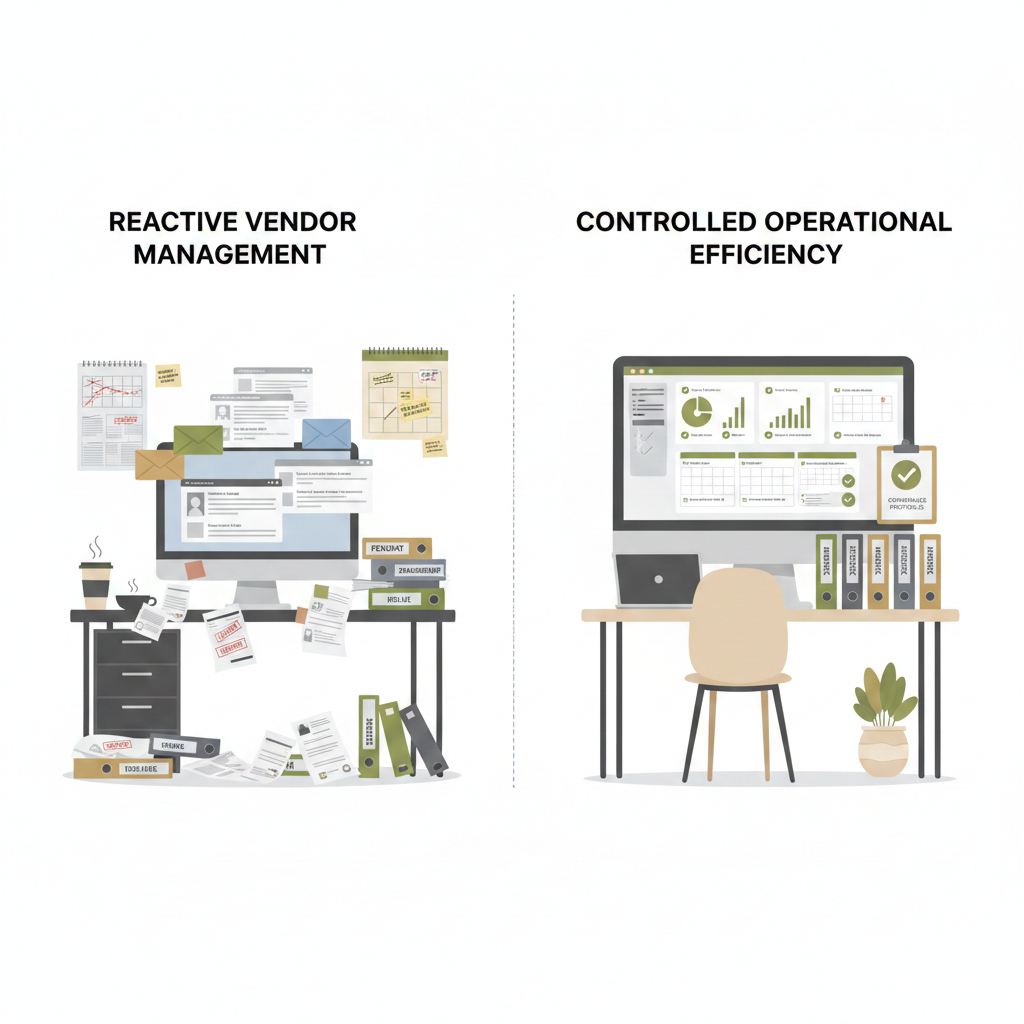
Efficient procurement is not heroic. It is boring by design.
It is repeatable.
It is predictable.
It is scalable.
It follows a process.
Efficient organizations do not reinvent decisions every time a contract comes up. They know what information they need. They know when to review. They know who is responsible.
Procurement stops being reactive and starts being controlled.
That is when efficiency compounds instead of eroding.
The Biggest Red Flag of Financial Inefficiency
There is one phrase that almost always signals trouble.
“We’ve worked with them for twenty years. We don’t really ask questions.”
Long relationships are not bad. Unquestioned ones are.
Comfort without scrutiny is rarely efficient. Vendors change. Pricing changes. Terms change. What made sense a decade ago may no longer align with how the business operates today.
Efficiency requires curiosity. Even when things seem fine.
How CFOs and Operations Leaders See Efficiency Differently
Efficiency means different things depending on where you sit.
For a CFO, efficiency is about profitability, predictability, and risk management. It protects margin and reduces surprises.
For operations leaders, efficiency is about capacity. Fewer distractions. More time back to teams. Less firefighting.
Problems arise when these definitions drift apart.
The most effective organizations align both views. Financial efficiency and operational efficiency reinforce each other when approached intentionally.
The Real Definition of Efficiency in Business
Efficiency is not about being cheap.
It is not about moving fast for the sake of speed.
It is not about cutting until something breaks.
Efficiency is about control.
Control over recurring spend.
Control over vendor relationships.
Control over time and attention.
Efficient organizations are not necessarily the lowest cost. They are the hardest to surprise.
And that is what makes efficiency valuable.